
Afro textured hair is one of the most rewarding hair types to restore and one of the easiest to get wrong. The very quality that gives coily hair its beauty, the tight curl, extends beneath the surface of the scalp in a way that makes extraction genuinely difficult. Standard tools designed for straight hair damage curved follicles at rates that can ruin an outcome. This is why an Afro hair transplant is not a procedure to hand to a general clinic, and why choosing a surgeon with real textured hair experience matters more here than almost anywhere else in hair restoration.
Turkey has become a leading destination for Afro hair restoration in 2026, but the country’s overall reputation does not automatically transfer to every clinic within it. This guide explains what makes textured hair different, how specialists handle it, what results and costs to expect, and how to identify a clinic that actually has the expertise rather than one that simply advertises it.

Why Afro Hair Is Harder to Transplant
To understand the challenge, you have to picture what a coily follicle looks like below the skin. In Afro textured hair, classified in the tighter curl ranges, the follicle does not descend in a straight line. It follows a curved, often C shaped or helical path beneath the surface, mirroring the curl you see above it. The hair is curly not just on top of the scalp but underneath it as well.
This matters enormously during extraction. A straight punch pushed down around a curved follicle will slice through it, a problem surgeons call transection. Published research shows that transection rates with standard rotary punches designed for straight hair can range dramatically higher for Afro hair, while specialized curved path tooling keeps transection low. A transected follicle is a wasted graft, so tooling and technique directly determine how many of the extracted follicles actually survive to grow.
There is a second consideration specific to patients of African descent: a higher baseline risk of keloid scarring. This makes a gentle, low trauma approach and careful donor management important, both to protect the result and to respect the skin. Este Favor addresses the curl challenge directly through its Curved Follicle Protocol, which adapts extraction to the natural angle and shape of coily follicles rather than forcing straight hair methods onto them.
The Techniques That Work for Coily Hair
The good news is that with the right tools and an experienced hand, Afro hair transplants achieve excellent results, with success rates that comfortably exceed ninety percent at specialist clinics.
FUE is the most common method for textured hair, but it must be performed with specialized curved or wider diameter punches that navigate the follicle’s shape without cutting it. When done correctly, it minimizes scarring, allows a reasonable recovery, and preserves graft viability. Sapphire FUE, using sapphire tipped blades to create finer recipient sites, is well suited to looser curl patterns and offers cleaner healing and less visible scarring, an advantage that matters given the keloid consideration.
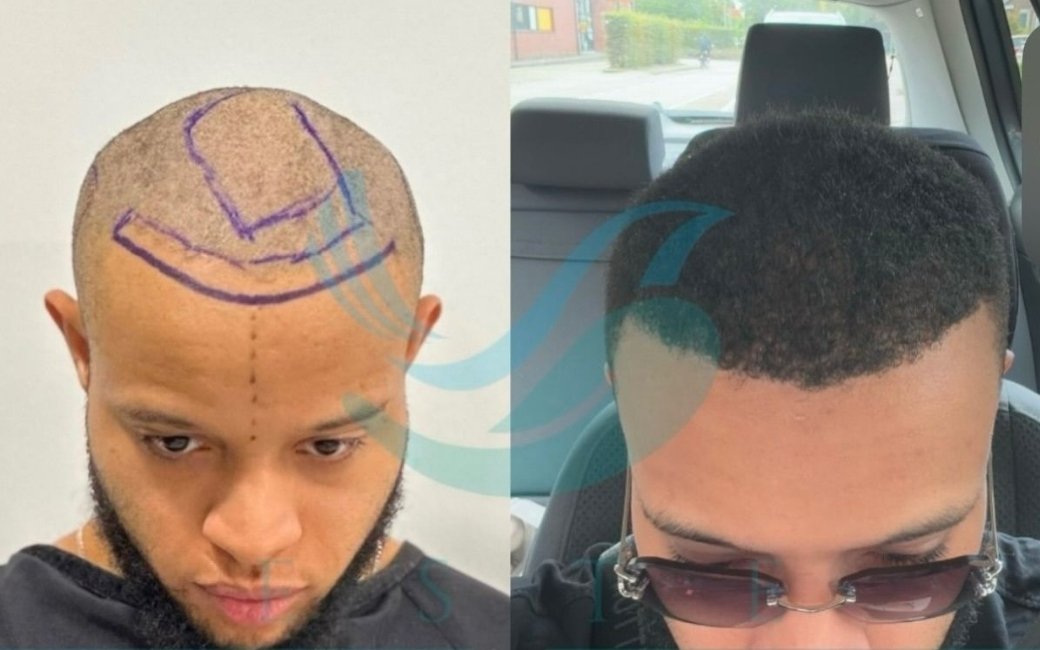
DHI, using the implanter pen, offers the highest precision for placement and reduces graft handling by implanting immediately after extraction, which can support survival. It works particularly well for smaller sessions and for hairline and temple work where accurate angle and direction are essential to recreate a natural coily hairline.
In practice, a specialist often blends these, choosing sapphire FUE for some zones and DHI for others depending on the curl class and the area being treated. Este Favor applies this judgment through its Hybrid Technique and Precision Extraction System, matching the method to the follicle rather than the other way around.
One Advantage of Textured Hair
It is worth pausing on a genuine benefit, because so much of the Afro hair conversation focuses on difficulty. Coily hair provides greater visual coverage per graft than straight hair. Because each curl occupies more visual space and creates the impression of volume, a given area can look full with fewer grafts than the same area would require in straight hair.
In concrete terms, Afro hair can achieve convincing visual fullness at a lower graft density than straight hair needs. This means that once the extraction challenge is handled well, textured hair patients often reach a satisfying result efficiently. Este Favor factors this into its planning with ai Hair Mapping, calculating the graft count around the coverage efficiency of coily hair rather than applying straight hair math to a curl pattern it does not fit.
Afro Hair Transplant Cost in Turkey in 2026
Pricing for textured hair sits slightly above straight hair procedures, which reflects the extra time, specialized tooling, and expertise the work demands. In 2026, an Afro hair transplant in Turkey generally ranges from roughly 2,500 to 5,000 US dollars depending on graft count, technique, and the clinic’s specialization. The curved root adaptation typically adds a modest premium over straight hair work.

The contrast with Western pricing is stark. An African American hair transplant in the United States commonly runs from 10,000 to 25,000 dollars, and specialist ethnic hair surgeons there charge at the higher end. Turkey delivers comparable specialist quality for a fraction of that, which is why the country has become a hub for patients seeking textured hair expertise at an accessible price.
Within Turkey, the price drivers are the familiar ones: graft count, technique choice, and above all the surgeon’s genuine experience with coily hair. This last factor is where patients should focus. A slightly higher fee from a proven textured hair specialist is far better value than a bargain from a clinic learning on your scalp.
What Results and Recovery Look Like
Recovery from an Afro hair transplant follows the same general arc as any FUE or DHI procedure, with a few textured hair specifics. Mild swelling and redness settle in the first week, crusts shed within roughly ten days, and the transplanted hairs go through a normal shedding phase in the first weeks before permanent regrowth begins.
The results timeline runs a little longer for coily hair. Early growth typically appears around months four to six, meaningful improvement by months eight to ten, and full results within roughly twelve to fifteen months, reflecting the slightly slower growth rate of Afro textured hair. Patience through this window is rewarded, and clear expectations prevent the discouragement that comes from watching the early shedding phase without understanding it.
Graft survival is the whole game with textured hair, and it depends on gentle extraction, minimal handling, and careful placement. Este Favor supports survival with its Precision Extraction System and Fibroblast Supported Healing System, and provides detailed guidance on caring for textured hair after transplant, including appropriate products and styling as the new growth comes in. Healing is tracked remotely through the Post-Op Digital Monitoring System so patients stay supported after returning home.

Caring for Textured Hair After a Transplant
Aftercare for coily hair deserves its own conversation, because the products and habits that suit textured hair differ from generic post transplant advice written with straight hair in mind. Afro textured hair tends to be drier by nature, since the curl makes it harder for natural scalp oils to travel down the hair shaft, and this influences how the scalp should be cared for during recovery.
In the early healing window, gentle washing with the clinic approved products is essential, and the scalp should be kept hydrated without heavy manipulation. As the new growth comes in over the following months, patients return gradually to their normal routine, but the transition needs to be thoughtful. High tension protective styles, the very styles that can cause traction damage, should be avoided or loosened to protect both the new grafts and the surrounding hair. Heat styling and harsh chemical treatments are best minimized while the follicles settle.
There is also the matter of curl pattern. A common worry among patients is whether transplanted hair will keep its natural curl, and the reassuring answer is that it does. Because the follicles are the patient’s own, the new growth follows the same curl pattern as the donor hair, blending naturally with the existing coily texture once it matures. Este Favor provides textured hair specific aftercare guidance rather than a one size fits all sheet, and monitors the healing remotely so patients caring for coily hair at home have expert support through the full growth cycle.

How to Choose a Clinic for Afro Hair
Because textured hair experience varies so much between clinics, the selection process deserves extra care. A few things separate a genuine specialist from an optimistic generalist.
Ask specifically about the surgeon’s experience with your curl class and request before and after results from patients with similar hair, not just straight haired cases. Confirm that the clinic uses tooling designed for curved follicles rather than standard punches. Ask how they manage keloid risk, since a specialist will have a clear protocol. And look for a documented graft survival figure for textured hair, since specialists track this and generalists often cannot.
Accreditation and hygiene standards matter too, but for Afro hair the decisive factor is demonstrated textured hair expertise. Este Favor treats coily hair as a specialty with dedicated protocols rather than an occasional case, which is the standard patients should hold every clinic to.
Understanding Curl Classes and Your Plan
Not all textured hair is the same, and a specialist plans around exactly where a patient falls on the curl spectrum. Looser curl patterns follow a less aggressive path beneath the scalp, which makes extraction somewhat more forgiving and widens the range of suitable techniques. Tighter, more coiled patterns curve more sharply below the surface, demanding the most specialized tooling and the steadiest, most experienced hand to keep transection low.

This is why a proper consultation for Afro hair does not just count grafts. It assesses the curl class, the caliber of the hair, the health and density of the donor area, and the keloid risk profile, then builds the surgical plan around all of it. For looser patterns, sapphire FUE may be an excellent choice. For the tightest patterns, careful DHI or manual extraction with curved tooling often delivers the most reliable survival. Matching the method to the curl is the difference between a plan built for your hair and a plan borrowed from someone else’s.
Este Favor assesses curl class as a core part of its planning, using ai Hair Mapping alongside a genuine reading of follicle shape to decide which zones receive which technique. This individualized approach, rather than a single method applied to every textured case, is what allows the clinic to protect grafts across the full range of coily hair types.
How Este Favor Approaches Afro Hair Transplants
Afro hair restoration is where the difference between a specialist and a volume clinic becomes impossible to hide. The curved follicle, the transection risk, and the keloid consideration all punish a one size fits all approach. Este Favor built its textured hair practice specifically to meet these challenges rather than working around them.
The clinic’s proprietary protocols were made for exactly this kind of work. The Curved Follicle Protocol adapts extraction to coily follicle shape. Donor capacity and coverage are planned with ai Hair Mapping around the efficiency of textured hair. The critical channel opening stage is performed only by the surgeon under the Doctor-Only Channel Opening Protocol. Survival is protected by the Precision Extraction System and the Fibroblast Supported Healing System, and recovery is followed with the Post-Op Digital Monitoring System. Combined with honest planning and real textured hair experience, this is what defines Este Favor’s approach to Afro and coily hair.
Textured hair deserves a clinic that understands its structure rather than one that hopes for the best. If you are considering an Afro hair transplant, the right first step is an assessment with a specialist who can read your curl pattern and plan around it.
