
The fundamental challenge for Americans researching hair transplants in Turkey is that the clinics most likely to produce poor outcomes look similar on the surface to the clinics most likely to produce excellent ones. Both have professional websites. Both show impressive before-and-after galleries. Both have patient coordinators who communicate well in English and respond quickly to inquiries. Both offer competitive pricing.
The difference is not on the surface. It is in the details that the surface is designed to conceal: who actually performs the surgical work, what the surgeon’s credentials are and whether they can be independently verified, how the graft count was determined, and what happens to the patient after they board their return flight to New York or Miami.
For American patients who cannot walk down the street to verify a clinic in person, and who do not have the established credential shorthand of ABHRS certification to use as a filter, the verification process must be more deliberate than it would need to be domestically. This article describes that process step by step.
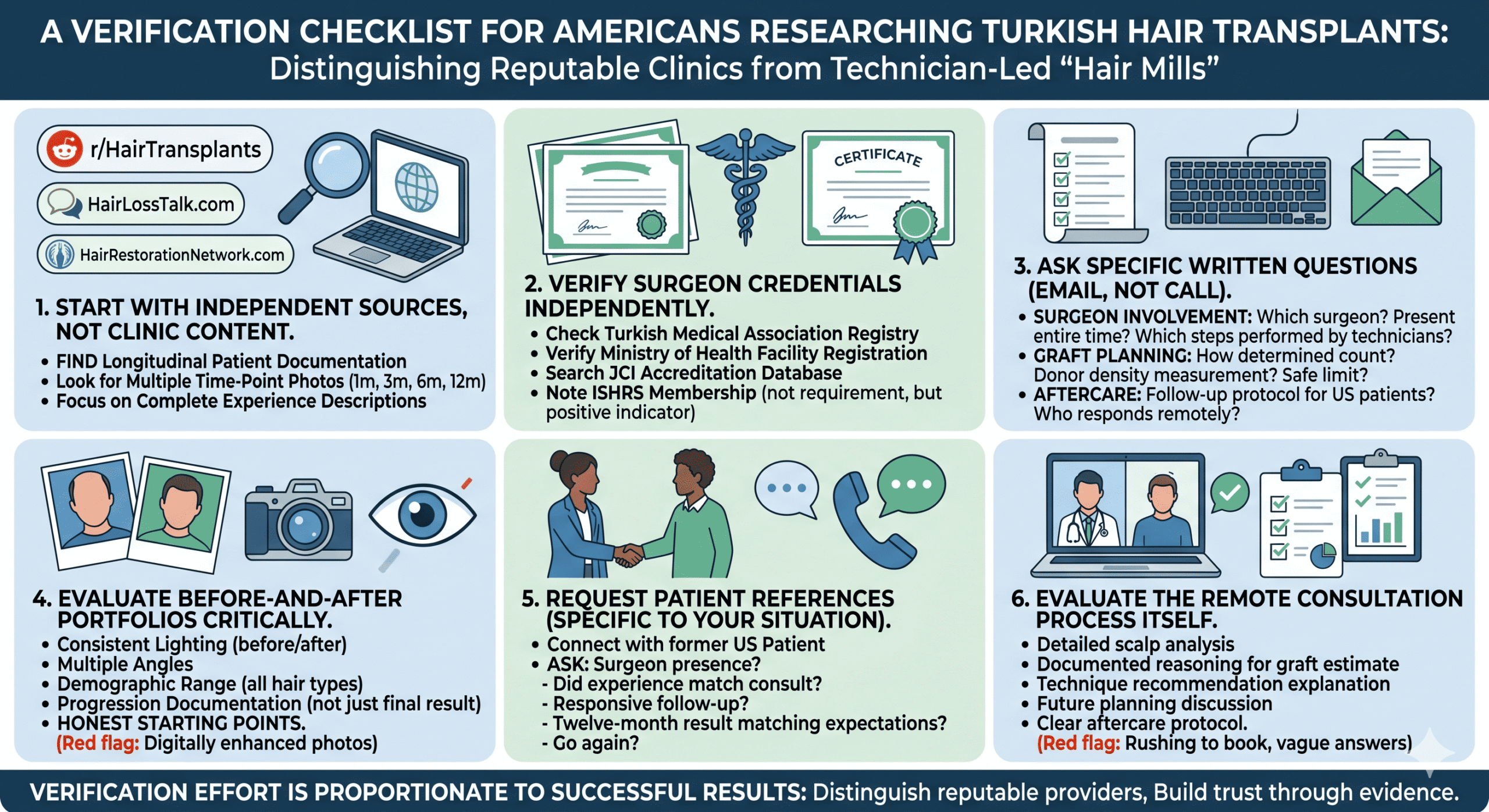
Step One: Start with Independent Sources, Not the Clinic’s Own Content
The worst place to begin evaluating a Turkish hair transplant clinic is the clinic’s own website, social media profile, or marketing materials. These sources are controlled by the clinic and designed to convert interest into bookings. They will emphasise strengths and omit weaknesses.
The best place to begin is independent patient documentation on forums that have no financial relationship with any clinic.
The most useful independent sources for American patients evaluating Turkish clinics are:
r/HairTransplants on Reddit: A large, active community with years of patient documentation. Search the clinic’s name combined with terms like “results,” “review,” or the patient’s home country. Look specifically for longitudinal posts: ones that show the scalp at multiple time points over a period of twelve months or more. A post showing only the twelve-month result without the progression cannot be independently verified for timeline.
HairLossTalk.com and HairRestorationNetwork.com: Established forums with long-running threads where patients document their experiences over years. These forums contain some of the most detailed, honest, and independently verifiable patient accounts available anywhere.
RealSelf.com: Has a hair transplant review section, though the reliability of RealSelf reviews is lower than the dedicated hair loss forums because the format favours short, star-rated reviews rather than the longitudinal documentation that makes forum posts genuinely verifiable.
When reading independent patient accounts, weight the following:
- Accounts with photographs at multiple time points (one month, three months, six months, twelve months)
- Accounts that describe the complete experience, including consultation, procedure day, and aftercare, not just the final result
- Accounts where the result photos and the patient’s description of their starting point are consistent with each other
- Accounts from patients whose hair type and loss pattern are similar to yours
Discount accounts that show only a final result with no progression, that contain language patterns suggesting they may have been incentivised or written by the same person, or that describe the experience in uniformly positive terms with no texture or minor criticisms.
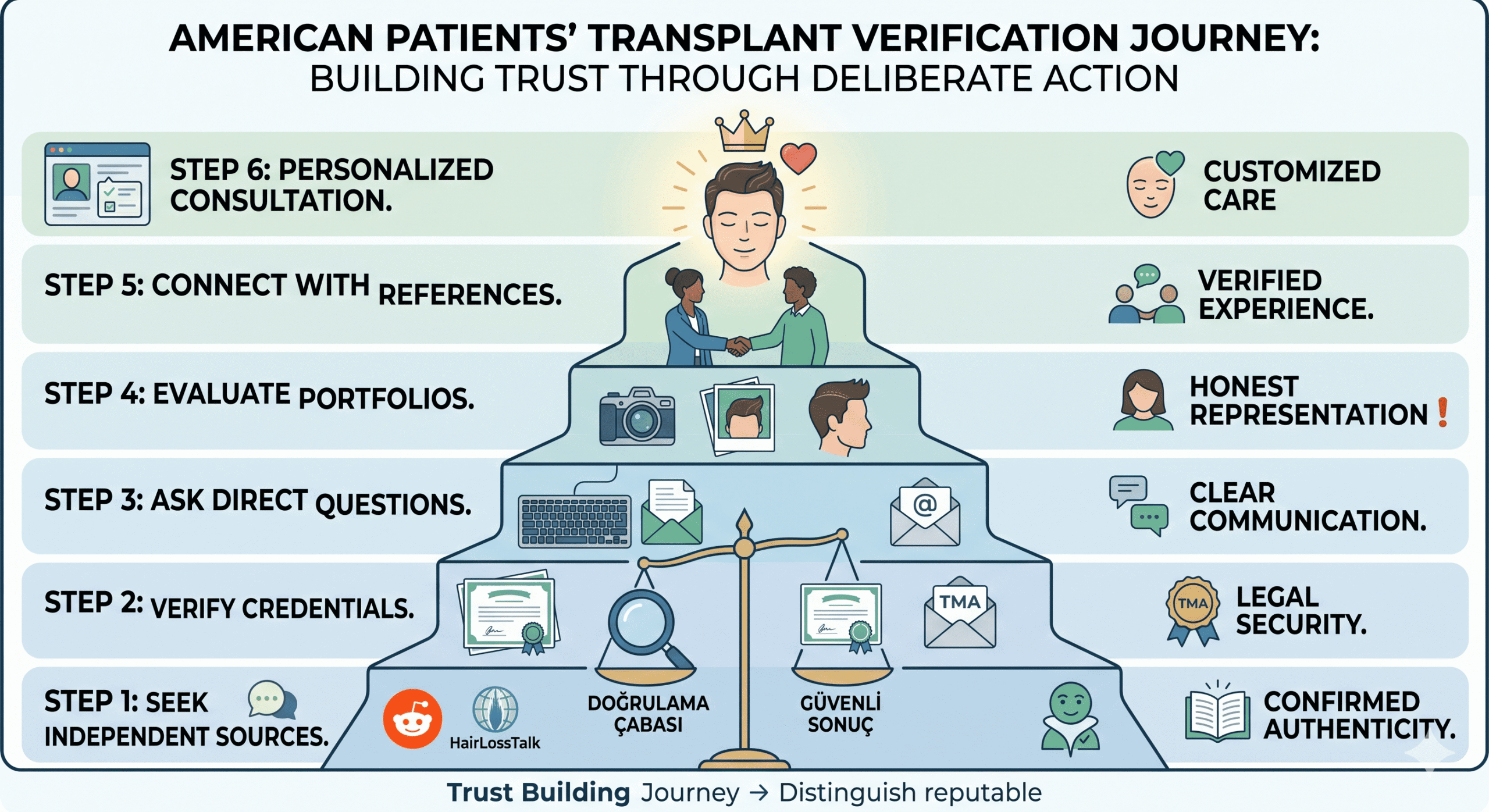
Step Two: Verify Surgeon Credentials Independently
Once a clinic has made the initial cut based on independent documentation, the next step is direct credential verification. This is where most American patients stop short: they ask the clinic about the surgeon’s credentials rather than verifying them independently. The clinic will always confirm that the surgeon is qualified. Independent verification is a different exercise.
Turkish Medical Association registry: Turkish physicians are registered with the Türk Tabipleri Birliği (TTB). The registry is publicly accessible and allows verification of a physician’s license status. A surgeon whose credentials cannot be confirmed in this registry is not a licensed physician under Turkish law, which is the foundational requirement.
Ministry of Health facility registration: Licensed Turkish clinics are registered with the Ministry of Health and have a registration number. Requesting this number from the clinic and verifying it through the Ministry’s public database confirms that the facility is operating within Turkey’s regulatory framework.
JCI Accreditation database: Joint Commission International, the international arm of the Joint Commission that accredits US hospitals, also accredits international healthcare facilities. JCI-accredited Istanbul facilities have undergone a documented quality assessment process. The JCI database is publicly searchable at jointcommissioninternational.org.
ISHRS member directory: The International Society of Hair Restoration Surgery maintains a searchable member directory. As of mid-2025, only 16 Turkish doctors are registered ISHRS members, so ISHRS membership is not a practical requirement for Turkish clinics. But for the small number of Turkish surgeons who are ISHRS members, the membership confirms professional engagement with the international hair restoration community.
The absence of ISHRS membership should not be used to rule a Turkish clinic out. Its presence should be noted as a positive indicator.
Step Three: Ask the Specific Questions That Reveal Clinic Quality
The questions that distinguish a reputable, surgeon-led Istanbul clinic from a technician-led hair mill are specific and direct. Reputable clinics answer them without evasiveness. Hair mills deflect, generalise, or provide technically accurate but misleading answers.

Send these questions in writing (email, not WhatsApp or a voice call) so you have a documented record of the responses:
On surgeon involvement:
- Which surgeon will perform my procedure?
- Will that surgeon be present in the operating room for the entire duration of the procedure?
- Which specific steps will the surgeon personally perform: hairline design, extraction, site creation, implantation?
- Will any steps be performed by technicians? If so, which ones, under what level of supervision?
On graft planning:
- How did you determine the graft count in my preliminary proposal?
- What was the donor density measurement used, and how was it measured?
- What is the maximum safe extraction limit from my donor area?
- How does this graft count account for my future hair loss progression?
On technique:
- Which technique do you recommend for my case: Sapphire FUE or DHI?
- Why is that technique appropriate for my specific hair type, loss pattern, and goals?
On aftercare:
- What is your follow-up protocol for American patients who return home after the procedure?
- How are assessments conducted remotely?
- Who specifically responds to patient queries between assessment points: a clinical team member or an administrative coordinator?
- What is your typical response time for patient questions during the recovery period?
On the clinic itself:
- What is your Ministry of Health registration number?
- Does the facility hold JCI accreditation or equivalent?
- Can you provide the surgeon’s Turkish Medical Association registration number?
Step Four: Evaluate the Before-and-After Portfolio Critically
Every Turkish hair transplant clinic has a before-and-after gallery. The gallery is the most heavily curated marketing asset the clinic produces, and it requires more critical analysis than most American patients apply to it.

What to look for in a credible portfolio:
- Lighting consistency: Before and after photos taken in the same lighting conditions. Before photos taken in harsh overhead light that exaggerates hair loss paired with after photos in soft, flattering light that adds volume is a common manipulation that makes results look more dramatic than they are.
- Multiple angles: Front, sides, top-down, and crown views for each case. A result shown only from the most flattering angle is hiding something.
- Demographic range: Cases showing patients with different hair types, including fine hair, curly hair, and lower density, not only the ideal high-calibre hair that photographs best.
- Progression documentation: Cases that show the scalp at multiple time points, not only the twelve-month result. A gallery composed exclusively of twelve-month results, with no shedding phase or early growth documentation, cannot be verified for timeline.
- Honest starting points: Before photos that clearly show the degree of hair loss being treated, not carefully styled photos that minimise the extent of the starting point.
Red flags in a portfolio:
- Suspiciously consistent results that all look equally perfect regardless of starting point
- No cases showing moderate or partial results
- Photos with visible digital enhancement around the hairline
- Before and after images that show different people due to lighting, angle, and styling rather than actual hair growth
Reverse image searching specific portfolio photos through Google or TinEye can reveal whether the same images appear under multiple clinic names: a clear sign of fabricated results.
Step Five: Request Patient References Specific to Your Situation
A clinic confident in its outcomes will connect prospective American patients with former patients who have consented to be contacted. The willingness to provide this connection is itself a quality indicator.

When reaching out to a reference, the most useful questions are:
- Was the surgeon personally present throughout the procedure?
- Did the experience match what was represented during the consultation?
- How responsive was the clinic’s follow-up team after you returned to the US?
- What does your result look like at twelve months, and does it match what you were led to expect?
- Would you go to this clinic again?
Speaking directly with an American who has been through the procedure at a specific clinic, seen the full twelve-month result, and can describe the clinical and logistical experience provides a quality of information that no portfolio or rating platform can match.
Step Six: Evaluate the Remote Consultation Process Itself
Before booking, every American patient should have a formal remote consultation with each clinic under serious consideration. This consultation is not just about getting a graft estimate and price. It is an evaluation of the clinic itself.
A high-quality remote consultation includes:
- Review of detailed scalp photographs from multiple angles
- Specific graft estimate with documented reasoning
- Technique recommendation with explanation
- Discussion of the patient’s hair loss progression and future planning
- Honest assessment of what can and cannot be achieved
- Clear explanation of the aftercare protocol for American patients
- Opportunity to ask the specific verification questions described above
A low-quality remote consultation looks like:
- A quick response that leads with price
- A graft estimate offered without any reference to the photographs provided
- Pressure to commit to a booking before specific questions are answered
- Vague answers to surgeon presence and aftercare questions
- Urgency messaging about limited availability or time-limited pricing
The quality of the consultation process is the best available preview of how the clinic operates in general. A clinic that engages seriously, specifically, and without pressure during the remote consultation is likely to operate with the same care throughout the patient experience.

A Verification Checklist for American Patients
To summarise the steps above in a format that can be used as a working reference:
Independent research:
- Searched clinic name on r/HairTransplants, HairLossTalk, HairRestorationNetwork
- Found longitudinal patient documentation with photos at multiple time points
- Cross-referenced with RealSelf and general search for clinic name plus “complaint” or “bad result”
Credential verification:
- Surgeon confirmed in Turkish Medical Association registry
- Clinic registration confirmed with Ministry of Health registration number
- JCI accreditation checked in JCI database (or equivalent documented)
Direct questions in writing:
- Surgeon presence throughout procedure confirmed in writing
- Specific role of surgeon and technicians in each procedure step documented
- Graft count determination process explained with reference to scalp assessment data
- Remote follow-up protocol for US patients described specifically
Portfolio evaluation:
- Consistent lighting across before and after photos
- Multiple angles shown per case
- Demographic range including various hair types
- Progression documentation at multiple time points
- No results that appear digitally enhanced
Reference contact:
- Spoke directly with at least one former American patient
- Confirmed surgeon presence, result quality, and follow-up responsiveness
Remote consultation quality:
- Consultation engaged specifically with individual photographs
- Graft estimate provided with reasoning
- Technique recommendation explained
- Questions answered directly without deflection or pressure
A clinic that clears every item on this checklist has demonstrated the transparency, clinical rigour, and patient orientation that distinguishes reputable Turkish providers from the hair mills that generate the incidents and warnings that make Americans nervous about the Turkey option in the first place.
How EsteFavor Approaches American Patient Verification
At EsteFavor, the verification process described in this article is not an obstacle to booking. It is the starting point for a clinical relationship.
Every remote consultation provides a detailed scalp analysis review, a specific graft estimate with documented reasoning, a technique recommendation appropriate to the individual patient’s characteristics and goals, and transparent answers to every question on this checklist. Surgeon credentials are openly verifiable through the channels described. Ministry of Health registration is documented. The twelve-month remote follow-up programme for American patients is specific, structured, and conducted by clinical team members rather than administrative coordinators.
American patients who work through the verification process on this checklist and apply it to EsteFavor will find that every item clears. That is not a coincidence: it is the point. The verification framework exists to identify the clinics that belong in this category, and EsteFavor is designed to be one of them.
‘Is a Hair Transplant in Turkey Safe for Americans? What ISHRS and ABHRS Data Actually Shows‘ – the broader safety context for American patients considering Turkey, including what ISHRS consumer alerts specifically target and what the evidence shows about outcomes at properly vetted Istanbul clinics.
Conclusion
Verifying a Turkish hair transplant clinic as an American patient requires more deliberate effort than evaluating a domestic provider, because the regulatory shorthand that provides baseline confidence in the US does not apply to Turkish facilities. That effort is not disproportionate to the decision being made or the money being saved.
The verification process described in this article (independent research, credential confirmation, specific written questions, portfolio analysis, reference contact, and consultation quality assessment) effectively distinguishes reputable Istanbul clinics from the hair mill operations that generate the industry’s worst outcomes. For American patients who complete it, the clinic they select at the end of the process is one that has earned trust through evidence rather than marketing. That is the foundation on which a successful Turkey hair transplant is built.
