
Americans who research hair transplants in Turkey eventually encounter a version of the same warning from US-based surgeons: going abroad means giving up your legal protections. No malpractice claim. No state medical board. No ABHRS accountability. No US courts.
This warning is accurate. American patients who have a hair transplant in Turkey do give up the legal protections that the US healthcare system provides domestically. Understanding exactly what those protections are, what they actually provide in practice, and how to weigh them honestly against the benefits of the Turkey option is a more useful exercise than either dismissing the warning or accepting it as a deal-breaker without examination.
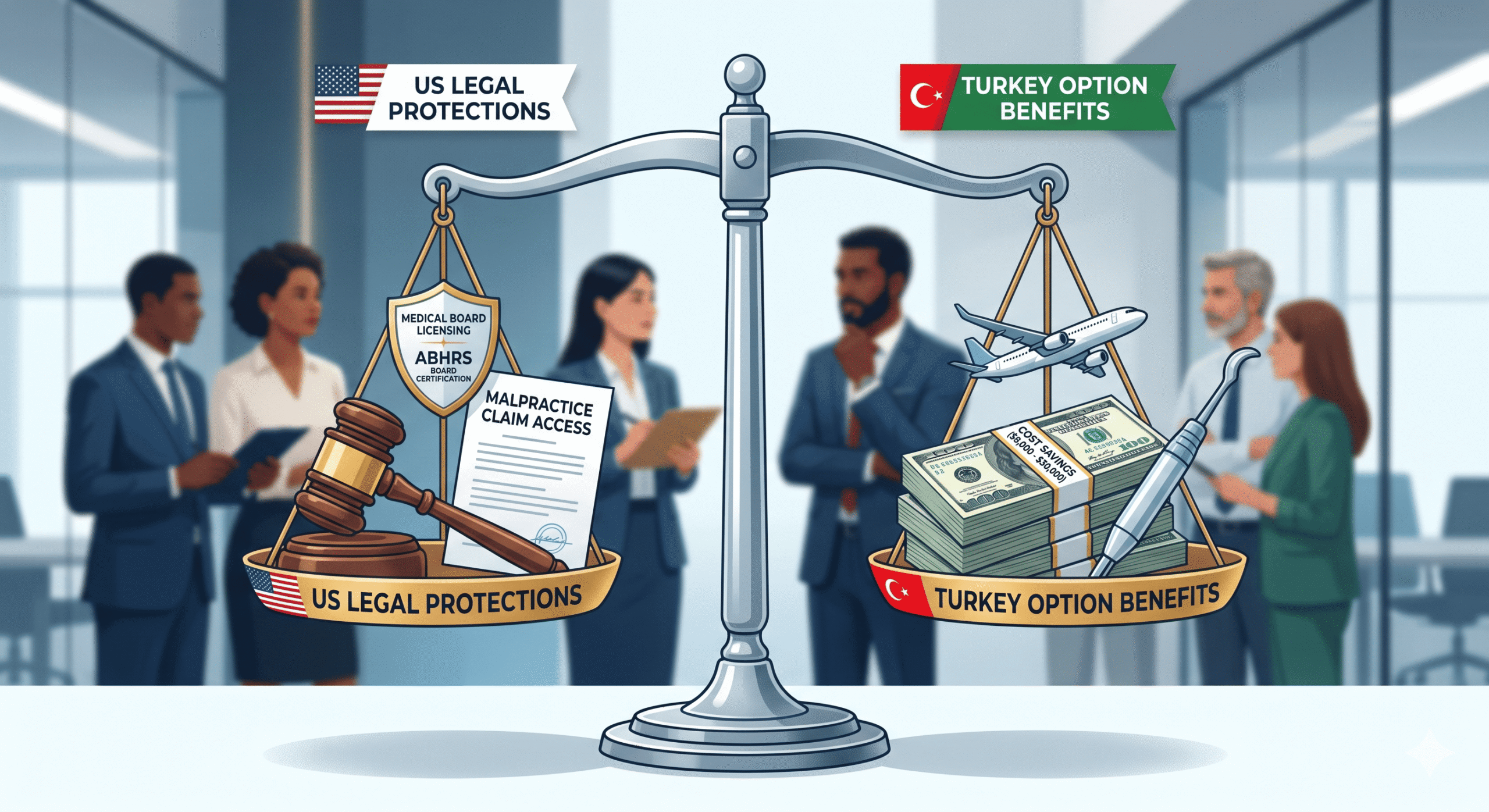
What US Legal Protections Actually Cover
When an American gets a hair transplant from a board-certified surgeon in their home country, they are operating within a multi-layer accountability framework that includes:
State medical board licensing: US surgeons must hold a valid medical license in the state where they practice. The licensing board sets standards for qualifications, ongoing education, and professional conduct. Patients who experience harm from a licensed US practitioner can file a complaint with the state medical board, which has investigative authority and the power to suspend or revoke a surgeon’s license.
ABHRS board certification: The American Board of Hair Restoration Surgery is the specialty board that certifies surgeons specifically in hair restoration. Board certification requires documented training, case volume, and a written examination. It provides a specific quality marker that distinguishes practitioners who have met a defined standard from those who have not. It is voluntary rather than mandatory, but it signals a level of professional investment in the specialty.
Malpractice insurance: US surgeons are required in most states to carry professional liability insurance. This creates a financial mechanism through which patients harmed by negligence can seek compensation without the surgeon needing personal assets to cover the claim. The malpractice insurance system also creates indirect accountability: insurers set standards, conduct risk assessments, and can decline coverage to practitioners with poor records, which removes those practitioners from the protected pool.
US court jurisdiction: If a patient suffers harm from a US procedure and pursues a malpractice claim, the case is heard in US courts under US law. The patient has access to US legal processes, can retain a US attorney on a contingency basis in most states, and operates within a legal system they understand and that is designed to be accessible.
These protections are real. They are worth something. The question is: how much are they worth in practice, and what do they actually cost?

What US Legal Protections Do Not Guarantee
It is important to be clear about what the US accountability framework does not provide, because it is often presented as a more complete protection than it actually is.
Malpractice claims are hard to win. The US medical malpractice litigation system is expensive, slow, and uncertain. The average malpractice case in the US takes two to four years from filing to resolution. Most plaintiffs require expert witnesses who charge thousands of dollars to testify. In hair transplant cases specifically, proving deviation from the standard of care is technically complex. Many attorneys will not take hair transplant malpractice cases on contingency because the damages are relatively limited compared to the litigation cost.
Board certification does not prevent poor outcomes. ABHRS-certified surgeons produce disappointing results. The certification indicates training and knowledge; it does not guarantee the specific outcome of any individual procedure. A patient who has a poor result from an ABHRS-certified US surgeon has the legal right to pursue a malpractice claim: but winning that claim is a different matter, and the process of pursuing it is expensive, lengthy, and emotionally taxing.
State medical board complaints rarely produce individual compensation. Filing a complaint with a state medical board may trigger an investigation. It may result in disciplinary action against the surgeon. It does not provide financial compensation to the patient who filed the complaint. The board process and the malpractice claim are separate tracks.
The US legal accountability framework provides a structure for accountability that does not exist in Turkey for foreign patients. That structure has genuine value. But presenting it as a reliable path to compensation or remedy for American patients who have bad outcomes from domestic procedures overstates what it typically delivers.

What Legal Protections Americans Do Not Have in Turkey
When an American has a hair transplant in Turkey and experiences a poor outcome, their legal options are limited in specific ways:
US laws do not apply. US federal and state laws, including the legal framework for medical malpractice, do not govern procedures performed in Turkey. A patient cannot bring a malpractice claim in a US court against a Turkish clinic for work done in Turkey.
Turkish malpractice law applies: but is difficult for foreign patients to use. Turkey has a legal framework for medical malpractice claims, and foreign patients have the same legal rights as Turkish patients in principle. In practice, pursuing a claim requires a Turkish attorney, Turkish court proceedings conducted in Turkish, and physical presence or representation in Turkey throughout the process. The practical barriers are high enough that very few foreign patients successfully pursue Turkish malpractice claims.
No ABHRS or equivalent Turkey-specific credential to verify. The ABHRS is a US body. Turkish surgeons are licensed through Turkey’s medical framework, not through ABHRS. The ISHRS notes that only 16 doctors in Turkey are registered ISHRS members as of mid-2025, making ISHRS membership an impractical filter for Turkish clinic selection.
Limited intermediary accountability. When an American books through a medical tourism broker or agency, there may be an additional layer between the patient and the clinic. Some brokers operate outside Turkey and outside US jurisdiction simultaneously, creating a situation in which neither US nor Turkish law provides a clear accountability mechanism if something goes wrong.
These limitations are real and should be factored into the decision. They are not arguments that Turkey is categorically unsafe: they are arguments that the verification work must be done by the patient rather than delegated to a regulatory system.
‘Is a Hair Transplant in Turkey Safe for Americans? What ISHRS and ABHRS Data Actually Shows‘: the safety evidence from ISHRS, ABHRS, and the 2025 Mayo Clinic study, contextualised for American patients evaluating Turkey as an option.
How to Compensate for the Absence of US Legal Protection
Since the legal accountability framework that exists in the US does not apply in Turkey, American patients need to build their own accountability layer through the clinic selection process. This is actually more effective than most patients realise, because the mechanisms that make a Turkish clinic safe are operational rather than legal in nature.

Here is what that looks like in practice:
Verify surgeon credentials directly. The Turkish Medical Association maintains records of registered licensed physicians. A surgeon whose credentials can be confirmed in this registry is a licensed doctor under Turkish law: which is the foundational legal requirement. This verification takes twenty minutes and confirms the most basic credential that matters.
Confirm physician presence throughout the procedure in writing. The token doctor or bait-and-switch problem: where a credentialed surgeon delegates the actual surgical work to unlicensed technicians: is the primary mechanism by which serious complications occur. Asking the clinic directly and in writing who will perform each stage of the procedure, and receiving a specific written response, creates a documented record of what was represented to you. It also distinguishes clinics that are comfortable with transparency from those that are not.
Use JCI accreditation as a baseline filter. Joint Commission International accreditation is the most widely recognised international standard for healthcare facility quality. JCI-accredited facilities in Istanbul meet documented standards for sterilisation, infection control, staff qualifications, and patient safety protocols. While JCI accreditation does not make a facility immune to poor outcomes, it provides a documented quality baseline that unaccredited facilities do not offer.
Request the clinic’s Ministry of Health registration number. All licensed Turkish clinics are registered with the Ministry of Health and can provide their registration number. Verifying this through the Ministry’s public registry confirms that the facility is operating within Turkey’s regulatory framework.
Review independent longitudinal patient documentation. Hair restoration forums that contain multi-year patient accounts with photographic documentation at multiple time points provide a form of quality evidence that no regulatory system provides: actual outcomes from real patients over real time. This evidence is patient-generated and independent of clinic marketing, which makes it the most reliable quality signal available to international patients.
Choose a clinic with a defined remote aftercare programme. A clinic that commits to a specific, structured twelve-month follow-up protocol for international patients: with defined assessment points, accessible contact channels, and documented clinical engagement: provides a form of ongoing accountability that continues after the American patient returns home.

The Practical Risk Profile Without US Legal Protection
For an American patient who completes the verification steps above and selects a clinic that clears every checkpoint, what is the actual risk profile without the US legal protection system?
The risk of a poor outcome is not primarily a function of legal protection. Legal protection is remedial: it provides options after a bad outcome has occurred. What determines whether a bad outcome occurs in the first place is the quality of the clinic, the qualifications of the surgical team, the rigour of the clinical process, and the appropriateness of the surgical plan for the patient.
A patient who has a procedure at a high-quality clinic: whether in New York or Istanbul: faces a low probability of a serious complication. A patient who has a procedure at a substandard clinic faces a higher probability: again, whether the clinic is in New York or Istanbul. The absence of US legal protection does not change the probability of a complication occurring; it changes the options available if one does.
The honest assessment is therefore: the absence of US malpractice protection is a meaningful disadvantage in worst-case scenarios, but for patients who select carefully and verify thoroughly, the probability of reaching a worst-case scenario is low. The advantage of selecting carefully is available to American patients going to Turkey in exactly the same way it is available to American patients staying home.
What Happens If You Return to the US with a Problem
For American patients who return home with a complication or a disappointing result from a Turkish procedure, the practical options are:
Remote consultation with the Istanbul clinic. A reputable clinic’s remote follow-up programme is the first resource for any post-operative concern. Many issues that arise in the weeks after the return home: shedding concerns, questions about healing, minor inflammation: can be assessed and managed remotely. The Istanbul clinical team knows the specifics of the procedure performed in a way that a US practitioner does not.
A US primary care physician or dermatologist. For concerns that have a local medical component: an infection that requires antibiotic treatment, for example: a US physician can assess and treat the condition independently of the Turkish clinic. Medicare and private insurance typically cover the GP consultation and any prescribed treatment, since the billing is for the US-based medical service rather than the overseas procedure.
A US hair restoration specialist. If the result at twelve months falls significantly short of expectations, a consultation with a US-based ABHRS-certified surgeon can assess what corrective options are available. Some US surgeons are reluctant to take on cases from overseas procedures; others will evaluate them on their merits. Finding a US specialist willing to provide an honest second opinion and, if warranted, corrective work is possible, though the corrective procedure will be subject to full US pricing.
Turkish legal process. Pursuing a malpractice claim through Turkey’s legal system is theoretically possible and practically very difficult. It requires Turkish legal representation, command of Turkish legal processes, and sustained engagement with foreign proceedings. Very few American patients pursue this path, and fewer succeed through it.
The honest conclusion: the practical remedy landscape for American patients who have problems after a Turkey procedure is limited but not empty. Remote clinical support, US medical treatment for local complications, and eventual corrective work from a US provider if needed are all available. What is not available is the US malpractice claim process: and for most patients whose outcomes fall short of expectations without constituting negligence, that process would not have been a practical remedy domestically either.

Weighing the Trade-Off Honestly
The legal trade-off for American patients considering Turkey comes down to this:
What you give up: The ability to file a malpractice claim in a US court if something goes wrong, the credential shorthand of ABHRS certification, and the state medical board accountability that licensed US surgeons operate under.
What you get in return: A saving of $8,000 to $30,000 on a procedure that is not covered by insurance regardless of where it is done, access to a surgeon who may have performed substantially more procedures than the equivalent US practitioner, an all-inclusive experience that bundles the procedure with hotel and aftercare, and the same twelve-month biological process producing permanent hair growth.
Whether this trade-off is worth making is a genuinely individual decision. For patients with elevated complication risk profiles, complex medical histories, or a high degree of risk aversion, the domestic option with its legal protections may be the appropriate choice regardless of cost. For patients who are good candidates, have no elevated risk factors, and are prepared to do the verification work that substitutes for the absent regulatory protection, the Turkey option is compelling.
Internal Link Box ‘Hair Transplant Cost in Turkey vs USA: New York, Miami and LA Price Comparison 2026‘: a side-by-side comparison of what reputable Turkish and American clinics offer across the dimensions that matter most to American patients: technique, surgeon accountability, aftercare, and long-term results.
Conclusion
American patients who go to Turkey for a hair transplant give up real legal protections. The US malpractice system, state medical board oversight, and ABHRS board certification are genuine accountability mechanisms that do not apply to procedures performed abroad.
These protections are worth something. They are not worth everything. They do not guarantee good outcomes domestically, they are not a reliable path to compensation when invoked, and they do not compensate for the cost gap that makes Turkey the financially rational choice for most American patients who need this procedure.
The appropriate response to the absence of US legal protection in Turkey is not to rule Turkey out. It is to do the verification work that substitutes for regulatory protection: confirming surgeon credentials, insisting on physician presence documentation, choosing accredited facilities, and selecting clinics with transparent track records. For patients who do this work well, the risk profile of a properly selected Turkish clinic is genuinely comparable to a domestic alternative: at a price that makes the comparison financially compelling.
