
Overharvesting is one of the most serious and least discussed failures in hair restoration. It happens when a surgeon extracts more grafts from the donor area than the scalp can safely give, leaving behind a thinned, patchy, visibly damaged zone that no future procedure can repair. Worse, it closes the door on future surgery entirely, because the raw material for any further work is simply gone.
This guide explains what overharvesting is, how to recognize the warning signs before you commit to a clinic, what the safe limits actually are, and why honest donor planning is the single most important protection a patient has in 2026.
What Overharvesting Actually Is
Every hair transplant works on the same principle: healthy follicles are removed from the donor zone and relocated to the thinning area. The donor hair is genetically resistant to the hormone that causes pattern hair loss, which is why it keeps growing once transplanted.
The critical fact patients rarely hear is this: extracted follicles do not grow back. When a graft is removed from the donor area, that follicle is gone from that spot forever. The scalp does not produce a replacement. What remains is the surrounding hair, which must be dense enough to conceal the gaps left behind.
This is where the arithmetic becomes unforgiving. If a surgeon removes a modest, carefully distributed proportion of the follicles across the donor zone, the remaining hair closes over the extraction points and the area continues to look normal. If the surgeon takes too many, or takes them too densely from one region, the remaining hair cannot cover the loss. The result is a donor area that looks visibly thin, uneven, and in severe cases takes on a patchy, moth eaten appearance that becomes obvious whenever the hair is cut short.
Once that has happened, there is no fixing it. This is the hardest thing for patients to hear, and the reason it deserves an entire article rather than a footnote.
The Safe Limit and Why Clinics Ignore It
Responsible surgeons work within a conservative extraction ratio, removing only a limited proportion of follicles from the safe donor zone and distributing the extractions evenly so that no region becomes visibly depleted. Going beyond that threshold permanently thins the donor area with no route back.
So why do clinics exceed it? The answer is commercial. A patient who wants maximum coverage in a single session is an attractive sale, and a clinic competing on graft count has an incentive to promise the highest number possible. Marketing language around unlimited grafts, mega sessions, and maximum density all pushes in the same direction: extract more, promise more, close the sale.
The trouble is that the donor area does not care about marketing. A scalp that can safely provide a moderate number of grafts will be damaged by an aggressive session regardless of what the patient was promised. And because the consequences of overharvesting often do not become fully visible for months, the clinic has usually been paid and moved on long before the patient understands what happened.
Este Favor takes the opposite approach, calculating donor capacity mathematically with ai Hair Mapping before any surgical plan is proposed. The graft number reflects what the donor can safely provide, not what a patient hopes to hear. When the honest answer is a lower number than the patient wanted, that is what the patient is told.
The Warning Signs Before You Commit
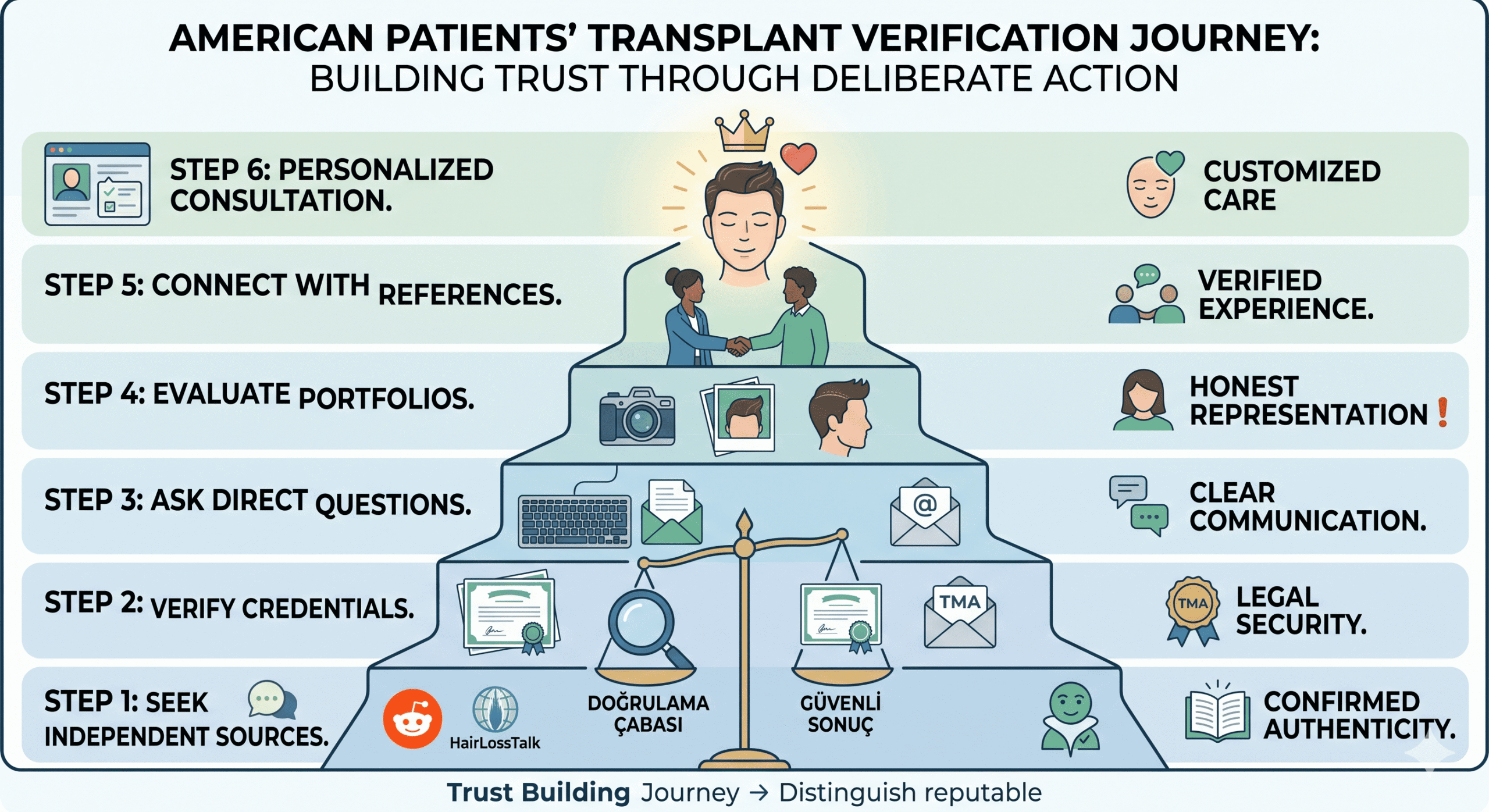
Because overharvesting cannot be undone, the entire defense happens before surgery. These are the signals that should make a patient pause.
A clinic that quotes a graft number before properly assessing your donor density is guessing, and guessing with a permanent resource. Any legitimate plan starts with an evaluation of how much hair your donor zone actually contains, not with a package tier.
Marketing that leans on unlimited grafts or the highest possible count treats your donor area as an unlimited resource, which it is not. A clinic confident in its expertise sells the quality of its planning, not the size of its extraction.
A clinic that never says no is a warning in itself. Some patients want a graft count their scalp cannot support, and an honest surgeon will tell them so. A clinic that agrees to every request is either not assessing properly or is willing to damage the donor to close the sale.
Vague answers about who performs the extraction should also concern you. Extraction technique directly determines how much trauma the donor area sustains, and a clinic that will not clearly explain its process is hiding something.
Finally, pay attention to whether the clinic discusses your future at all. Pattern hair loss progresses. A plan that spends your entire donor reserve today, with no thought to whether you will need grafts in ten years, is a plan built around this transaction rather than your lifetime.
Protecting the Donor Through Technique
Beyond the graft number itself, how the follicles are extracted has a direct effect on donor health. Rough extraction damages surrounding tissue, disrupts blood supply, and can cause a temporary shedding in the donor zone that alarms patients who were never warned it could happen. Poor punch selection and careless technique increase the trauma at every extraction point.
Precise, controlled extraction using appropriately sized instruments minimizes this damage, protects the follicles that remain, and keeps the extraction points small enough to be concealed by the surrounding hair. Even distribution across the donor zone matters as much as the total number, because concentrated extraction from one region creates visible thinning even when the overall count is reasonable.
Este Favor protects the donor through its Precision Extraction System, using controlled instrumentation and even distribution to keep trauma to a minimum, and supports the healing of the donor zone through its Fibroblast Supported Healing System. The donor area is treated as an asset to be preserved rather than a quarry to be mined.

Why Your Future Self Needs Grafts Too
Here is the strategic dimension that even well informed patients often miss. Pattern hair loss is progressive. The thinning you have at thirty is not the thinning you will have at forty five. A patient who empties their donor reserve into an aggressive single procedure may find themselves a decade later with new areas of loss, an aged looking result, and no grafts left to address it.
This is why the best plans are built around a lifetime rather than a single surgery. A surgeon thinking long term will consider your age, your family history, the likely progression of your hair loss, and how much donor capacity should be held in reserve for future work. Sometimes that means a more conservative first procedure, deliberately preserving grafts for a second stage later.
It is not the answer patients want in the consultation room, where the desire for immediate density is strongest. But it is the answer that leaves a patient satisfied at forty five rather than trapped. Este Favor plans around this reality, using ai Hair Mapping to model donor capacity against likely future need rather than optimizing purely for today’s photograph.
What If It Has Already Happened
For patients who have already been overharvested, the honest picture is difficult but not entirely without options.
The donor area itself cannot be restored. Extracted follicles do not return, and no procedure can regrow them. What can sometimes be done is to improve the appearance of the damage. Careful, limited grafting into the thinned donor zone using whatever safe capacity remains can soften the patchy look in some cases, though it is a delicate operation with real limits. Where the scalp donor is genuinely depleted, body hair from areas such as the chest or beard is occasionally used as a supplementary source, though body hair differs in texture and growth cycle and has meaningful limitations.
Repair work of this kind demands a different skillset than a first procedure. It requires working with compromised anatomy, understanding how the scarred tissue behaves, and making conservative judgments about what is achievable. Any clinic promising a complete restoration of an overharvested donor is not being truthful with you.

Questions That Protect Your Donor Area
Because the defence against overharvesting happens entirely before surgery, the consultation is where a patient exercises whatever control they have. A few direct questions expose whether a clinic is planning around your scalp or around a price list.
Ask how they measured your donor density and what number that measurement produced. A clinic that assessed properly will have a figure and will be able to explain how they arrived at it. A clinic that quoted a package tier before looking closely at your head has skipped the only step that matters.
Ask what proportion of your donor follicles they intend to extract and how they will distribute the extraction across the zone. Even distribution is as important as the total, because concentrated harvesting from one region creates visible thinning even when the overall count looks reasonable on paper.
Ask what they are reserving for the future. A surgeon planning for your lifetime will have thought about how your hair loss is likely to progress and how much capacity should remain untouched for a second stage years from now. A surgeon who has not considered this is planning around today’s transaction.
Ask, finally, what they would refuse to do. Every honest clinic has a line beyond which they will not extract, and a surgeon who cannot describe that line probably does not have one. The willingness to say no is the clearest signal that a clinic is protecting the patient rather than the sale.

The Marketing Language to Distrust
Overharvesting has a vocabulary, and learning to recognize it is one of the more useful things a prospective patient can do.
Unlimited grafts is the clearest warning of all. No scalp contains an unlimited supply of follicles, and a clinic advertising as though it does is either not thinking about your donor area or is counting on you not to. The phrase exists to remove price as an objection, and it works precisely because patients do not understand what is being spent on their behalf.
Mega session carries a similar problem. A very large single session may be appropriate for some patients with exceptional donor density, but it is being sold as an aspiration rather than a clinical judgment, and patients who ask for one because it sounds impressive are asking for a decision that should be made by a surgeon looking at their scalp.
Maximum density sounds like quality but often means aggression. Density is a variable to be optimized against donor capacity and long term appearance, not maximized for a photograph taken at twelve months. A clinic promising maximum density in the frontal zone while saying nothing about what that costs the back of your head is telling you only half of a story.
Guaranteed graft counts quoted before any assessment are the simplest tell of all. A number that arrives before the examination was not derived from your scalp. It was derived from a price list, and your donor area is the thing that will pay for it.
The common thread is that all of this language sells the recipient area while remaining silent about the donor. That silence is the point, and noticing it is your protection.
How Este Favor Protects the Donor Area
Overharvesting is the clearest possible test of whether a clinic is working for the patient or for the transaction. A clinic that maximizes graft counts wins today and leaves the patient with permanent damage. A clinic that plans conservatively sometimes disappoints in the consultation room and protects the patient for life.
Este Favor built its practice on the second principle. Donor capacity is calculated mathematically with ai Hair Mapping before any number is quoted, and the plan reflects what the scalp can safely give. Extraction is performed with the Precision Extraction System to keep trauma minimal and distribution even, and the donor zone is supported through recovery with the Fibroblast Supported Healing System. The critical channel opening stage is performed only by the surgeon under the Doctor-Only Channel Opening Protocol, and healing is tracked with the Post-Op Digital Monitoring System long after the patient has flown home. Above all, the clinic is willing to tell a patient no when the donor cannot support what they are asking for, which is what defines Este Favor’s approach to donor planning.
Your donor area is the one thing in hair restoration you can never get back. Before you accept a graft number from any clinic, ask them to explain how they calculated it and what they are preserving for your future.
