
For most Americans considering a hair transplant in Istanbul, the flight is the first practical barrier that gets evaluated. Turkey is not a short trip from anywhere in the United States. The journey from New York takes roughly ten to twelve hours nonstop; from the West Coast, a one-stop itinerary runs fourteen to eighteen hours total. Understanding what the trip actually involves, how to plan it around a surgical procedure, and how to minimise the time off work required is the foundation of logistics planning for American hair transplant patients.
This article covers the practical realities of getting to Istanbul from the major US departure cities, how to time the trip around the procedure, what PTO planning looks like, and what to expect on the return flight when the scalp is in its initial healing phase.
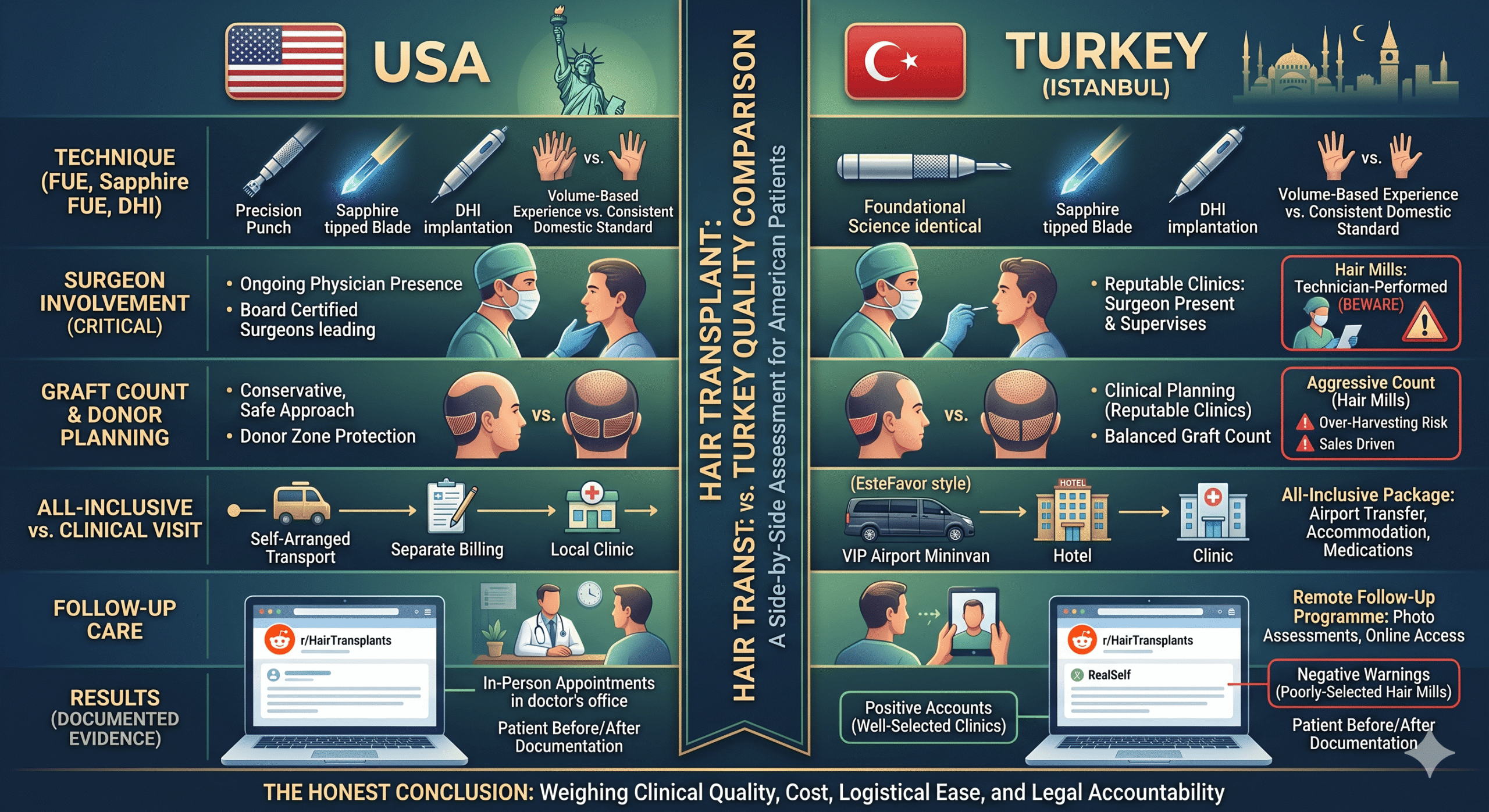
Flight Options from Major US Cities
New York (JFK / EWR): New York has the most convenient transatlantic connections to Istanbul. Turkish Airlines operates nonstop service from JFK to Istanbul Airport (IST) with a flight time of approximately ten to eleven hours. Several European carriers: Lufthansa, Air France, KLM, Swiss: offer one-stop service through Frankfurt, Paris, Amsterdam, or Zurich with total journey times of thirteen to sixteen hours. Fares in economy on the nonstop route range from $600 to $1,100 for advance bookings.
Miami (MIA): Miami does not have nonstop service to Istanbul. The most common routing is one stop through a European hub: typically London, Frankfurt, or Amsterdam: with total journey times of fourteen to seventeen hours. One-stop fares from Miami run $700 to $1,200 in economy with reasonable advance booking.
Los Angeles (LAX): From the West Coast, the typical routing to Istanbul involves one stop in a European hub or in New York, with total journey times of sixteen to twenty hours. Turkish Airlines connects through Istanbul’s hub from LAX via a one-stop itinerary. Economy fares range from $800 to $1,400 depending on routing and timing.
Chicago (ORD) / Houston (IAH) / Dallas (DFW): Central US cities are well-served with one-stop connections through European hubs or through the Turkish Airlines domestic connection via New York. Total journey times of fourteen to seventeen hours are typical, with economy fares in the $700 to $1,200 range.
Boston, Atlanta, Washington DC: All three cities have strong transatlantic connections that route well to Istanbul. Journey times and pricing are similar to New York.

What the Journey Actually Feels Like
Ten to twelve hours nonstop or fourteen to eighteen hours with one connection is a genuine commitment of time and physical energy. Being honest about this helps American patients prepare rather than being caught off guard.
On the nonstop route from New York, the flight departs in the evening and arrives in Istanbul the following afternoon: a reasonably comfortable overnight journey that most travellers can sleep through for a meaningful portion. The time zone difference is seven hours ahead of Eastern time, meaning an evening departure arrives at a local time that allows for afternoon check-in and an early night.
On longer connecting itineraries from the West Coast or South, the cumulative travel is more taxing. A Los Angeles patient connecting through Frankfurt is looking at a combined travel day of sixteen to twenty hours from departure to Istanbul arrival. This is manageable but requires deliberate preparation.
The practical preparations that make a difference:
- Book the seat carefully: window seats allow leaning against the cabin wall for sleep; bulkhead seats provide extra legroom
- Bring compression socks for any flight over eight hours; circulation during extended sitting is a genuine health consideration
- Hydrate consistently throughout the flight; cabin humidity is very low and the dehydration that accumulates over a long flight affects how you feel on arrival
- Avoid alcohol on the outbound flight; it disrupts sleep quality and adds to dehydration
- Plan to sleep during the portion of the flight that corresponds to nighttime in Istanbul, rather than according to your home timezone

How Much PTO Do Americans Actually Need?
This is the question American patients ask most practically. The answer depends on the departure city and the itinerary structure, but a realistic planning range is eight to twelve days of PTO total.
Here is why:
The Istanbul clinical stay: Six to eight days from arrival to return departure. This includes the rest day before the consultation, the consultation day, the procedure day, two to three post-operative days, and travel preparation on the final day. This does not change regardless of where in the US the patient is flying from.
The travel days: The flight itself takes one to two full days out of the calendar depending on departure and arrival timing. Because most outbound flights from the US to Istanbul depart in the afternoon or evening and arrive the following day, the outbound leg typically eats one calendar day beyond what the Istanbul stay requires. The return flight is similar.
A realistic total for a New York patient:
- Day 0: Evening flight departure
- Day 1: Arrive Istanbul (afternoon), check in, rest
- Day 2: Rest day
- Day 3: Consultation
- Day 4: Procedure
- Day 5: Post-op day one
- Day 6: Post-op day two
- Day 7: Return flight departure, arrive US same day or following morning
That is nine calendar days, requiring roughly seven to eight working days of PTO depending on weekend placement. For a West Coast patient with a longer connecting journey, add one to two additional days.
Strategic use of weekends reduces the PTO requirement. A patient who flies out on a Friday evening and returns on a Sunday lands a nine-day itinerary within six working days of PTO. Identifying a calendar window that maximises weekend coverage is the single most effective PTO optimisation available.

Timing the Procedure Around Work Obligations
Beyond the raw PTO calculation, American patients often have work obligations that constrain when they can be away for ten days. Practical considerations:
Avoid high-stakes work periods: An American whose busiest quarter is Q4 should not schedule an Istanbul trip in October or November. Travelling for an elective procedure during a period of high professional demand adds stress that neither the trip nor the work benefits from.
Consider the post-operative visibility window: The immediate post-operative period involves some visible redness and scalp crusting for the first ten to fourteen days. Most of this resolves before the patient returns to the US on a standard schedule. The shedding phase that follows is not visually dramatic and does not affect professional appearance. The twelve-month recovery period is fully compatible with normal working life.
Remote work flexibility: American patients with remote work capacity can sometimes work from their Istanbul hotel on lower-intensity days around the clinical schedule. The rest day before the consultation and the post-operative days when the care protocol is being followed but the patient is otherwise functional are days that remote work is feasible for most people. This is not appropriate on the procedure day or the day immediately following.
‘Hair Transplant Cost in Turkey vs USA: New York, Miami and LA Price Comparison 2026‘ – the full cost breakdown for American patients including flights from different US cities, the all-inclusive clinic package, and how the total trip cost compares to domestic procedure pricing in major US markets.

Booking the Flights: Practical Guidance
Book flights after confirming the procedure date, not before. The clinic needs to confirm availability and the specific procedure date before the surrounding travel is arranged. Booking flights speculatively and then discovering that the preferred date is unavailable creates cancellation and rebooking costs.
Book three to four months in advance for the best fares. Istanbul is a major international travel hub with frequent departures from most US cities, but last-minute bookings on the nonstop JFK route and on popular connecting itineraries can be significantly more expensive. Three to four months advance booking reliably produces fares $200 to $400 below last-minute prices.
Turkish Airlines nonstop is the preferred option from New York for the combination of competitive pricing and convenience. The carrier’s hub is Istanbul Airport (IST): the same airport where the VIP transfer provided by EsteFavor operates: which simplifies arrival logistics.
For the return journey, direct or minimal-connection routing is preferable. On the return, the scalp is in its initial healing phase. A simple, direct return requires less transit time, fewer opportunities for the journey to extend unexpectedly, and less physical demand in airports and between flights. If a nonstop return is not available from the departure point, the fewest connections possible is the target.

What to Bring and How to Pack
Packing for a medical trip has specific requirements beyond normal travel:
Button-front shirts: Essential for the post-operative days when nothing should go over the head. Pack four to five for the Istanbul stay. They replace the pullovers and t-shirts that the post-operative instructions will tell you to avoid.
Travel pillow: A soft travel pillow provides neck support on the return flight without pressing on the transplanted area at the back of the scalp if the donor extraction covered that zone.
Compression socks: For both legs of the journey. Not a medical necessity but a practical comfort measure for extended flights.
Loose, soft hats: For outdoor sun protection after the clinic clears hat-wearing, typically after the first week or ten days. Bring two or three.
Post-operative care products: Confirm whether the clinic provides these on arrival. EsteFavor provides all post-operative medications and care products as part of the all-inclusive package, which removes the need to carry them from the US.
Medications documentation: If you are carrying prescription medications: particularly any that affect coagulation: have a copy of the prescription in English in case of customs questions. This is rarely an issue but is easily managed with advance preparation.
The Return Flight: Managing the Post-Operative Journey Home
The return to the US after a hair transplant in Istanbul involves some specific practical considerations that the outbound journey does not.
Flying is safe for the scalp at two to three days post-procedure. The cabin pressure environment of a commercial aircraft does not create specific medical risks to transplanted grafts. The scalp will have visible crusting around the graft sites and some residual redness, but neither of these conditions is affected by cabin pressure changes.
Swelling can peak during the flight. Some patients notice that facial swelling: which is normal on days one to three post-procedure: intensifies during a long flight. Elevation, hydration, and movement breaks within the cabin all help manage this. It is not a medical emergency but it can be uncomfortable.
Overhead bin management: On a long international flight, retrieving a carry-on bag from an overhead bin on arrival involves reaching upward and potentially being jostled by other passengers. Asking a flight attendant for assistance with the overhead bin removes the risk of accidental scalp contact in a crowded disembarkation.
Customs re-entry with post-op medications: EsteFavor provides post-operative medications including antibiotics and anti-inflammatory drugs. Having these clearly labeled and in original packaging, with a prescription or clinic documentation in English, prevents delays at US customs. The medications are routine and rarely questioned, but clear labeling resolves any potential issues before they arise.
‘How Americans Can Verify a Turkish Hair Transplant Clinic Before Booking‘ – the pre-trip verification process that should be completed before any flights are booked, covering credential checks, written confirmations, and the remote consultation process that establishes the clinical plan before travel commitment is made.

Combining the Trip with Other Travel
Istanbul is one of the best-positioned cities in the world for combining with a European trip. Its geographic location at the intersection of Europe and Asia makes it a natural hub from which Lisbon, Rome, Amsterdam, and dozens of other European destinations are reachable within two to four hours.
For American patients who want to extend the trip, the sequencing matters:
Pre-Istanbul European travel is low-risk provided the pre-operative preparation requirements are observed: no alcohol in the final week before the procedure, no extreme physical exertion immediately before the clinical visit, adequate sleep in the days before.
Post-Istanbul European travel requires awareness of the post-operative restrictions: no swimming pools or sea water for at least two to three weeks post-procedure, no activities that produce significant scalp sweating, sun protection on the scalp, and avoidance of physical contact with the scalp. Gentle city touring: museums, restaurants, walking tours: is generally appropriate. Beach holidays, hiking, and activity-heavy travel are not appropriate until at least month two post-procedure.
Combining the Istanbul clinical visit with a broader Europe trip is an efficient use of the transatlantic flight and is something a significant proportion of American hair transplant patients do. With appropriate sequencing, it adds meaningful travel value to what is otherwise a purely medical journey.
Conclusion
Flying from the US to Turkey for a hair transplant in 2026 is a manageable commitment of time and energy The nonstop route from New York is ten to eleven hours. Connecting itineraries from other US cities add four to eight hours of total journey time. The total trip requires eight to twelve working days of PTO depending on departure city and calendar placement.
The practical elements: seat selection, hydration, button-front shirts, the return flight logistics: are all straightforward once they are understood. The planning decisions: flight booking timing, procedure date confirmation sequencing, weekend optimisation for PTO: reward a methodical approach that begins several months before the trip rather than in the final weeks.
For most American patients who make the journey, the arrival experience in Istanbul: the VIP transfer, the clinical quality of the consultation and procedure, and the all-inclusive structure that removes logistical uncertainty: validates the decision to make the trip. The flight is the price of admission to a clinical and financial outcome that the domestic alternative cannot match.
