
When an American patient boards the return flight from Istanbul, the surgical portion of the hair transplant process is complete. What begins on landing at JFK, LAX, or MIA is the longer, less dramatic, and ultimately more consequential part: the twelve-month biological process during which the transplanted follicles shed, rest, and then grow the permanent hair that was the purpose of the entire trip.
Managing this process from the United States, without the ability to walk into the Istanbul clinic for a quick check, requires a specific approach that combines clear biological understanding, consistent adherence to the care protocol, and smart use of the remote follow-up programme. American patients who manage this period well reach the twelve-month mark with results that match or exceed their pre-procedure expectations. Those who manage it poorly, by panicking at normal developments, abandoning the care protocol, or failing to engage with the remote support available, often have unnecessarily difficult recoveries.
This guide covers the full twelve months month by month, with honest accounts of what each phase involves and practical guidance for managing it from the US.
Before You Leave Istanbul: Setting Up for Remote Recovery
The most important recovery preparation happens before the return flight, not after. Before leaving the clinic for the final time, an American patient should have:
Written aftercare instructions covering the first four weeks in full. The washing protocol, the products to use, the activities to avoid and the specific timelines for when each restriction lifts, the expected developments and what distinguishes normal variation from concerning signs. These instructions should be specific, not generic.
Confirmed access to the remote follow-up channel. Whether this is a clinic email address, a patient portal, or a messaging application, the patient should have tested this channel with a message before leaving Istanbul and should have the contact details saved in multiple locations, including offline.
The clinic’s documentation in English. A letter or summary describing the procedure performed, the graft count, the technique, the date, and the medications prescribed. This document is useful for any US practitioner who may be involved in follow-up care, for customs re-entry, and for the patient’s own records.
Scheduled follow-up assessment dates. The first remote assessment is typically at one month. Know when it is, what it involves, and how photographs should be prepared and submitted.
Weeks One and Two: The Immediate Post-Return Period
Most American patients return home in the first or second week after their procedure, during the acute healing phase when the care protocol is most intensive.
The scalp during this period shows small crusts around each graft site and some residual redness that is progressively resolving. These crusts should not be picked at or forced off; they resolve naturally by days ten to fourteen. Following the prescribed washing routine precisely during this period is the highest-leverage action the patient can take to support graft survival.
Activity restrictions remain in effect: no swimming, no saunas, no significant physical exertion that causes sweating, no direct sun exposure to the scalp without protection. For American patients returning to summer conditions in the South or Southwest, the sun restriction is the most practically demanding element. A wide-brimmed hat or SPF coverage for outdoor exposure is the management approach.
Sleep position continues to matter in the first two weeks. Sleeping with the head elevated reduces fluid accumulation that produces forehead swelling. Most patients find that the swelling has significantly resolved by the time they fly home, but the elevated position remains advisable through the end of week two.
By the end of week two, the crusting has typically resolved and the scalp looks broadly similar to its pre-procedure state. The transplanted hairs are present but not dramatically visible. The skin is healed at the surface level.
Weeks Three to Six: The Shedding Phase
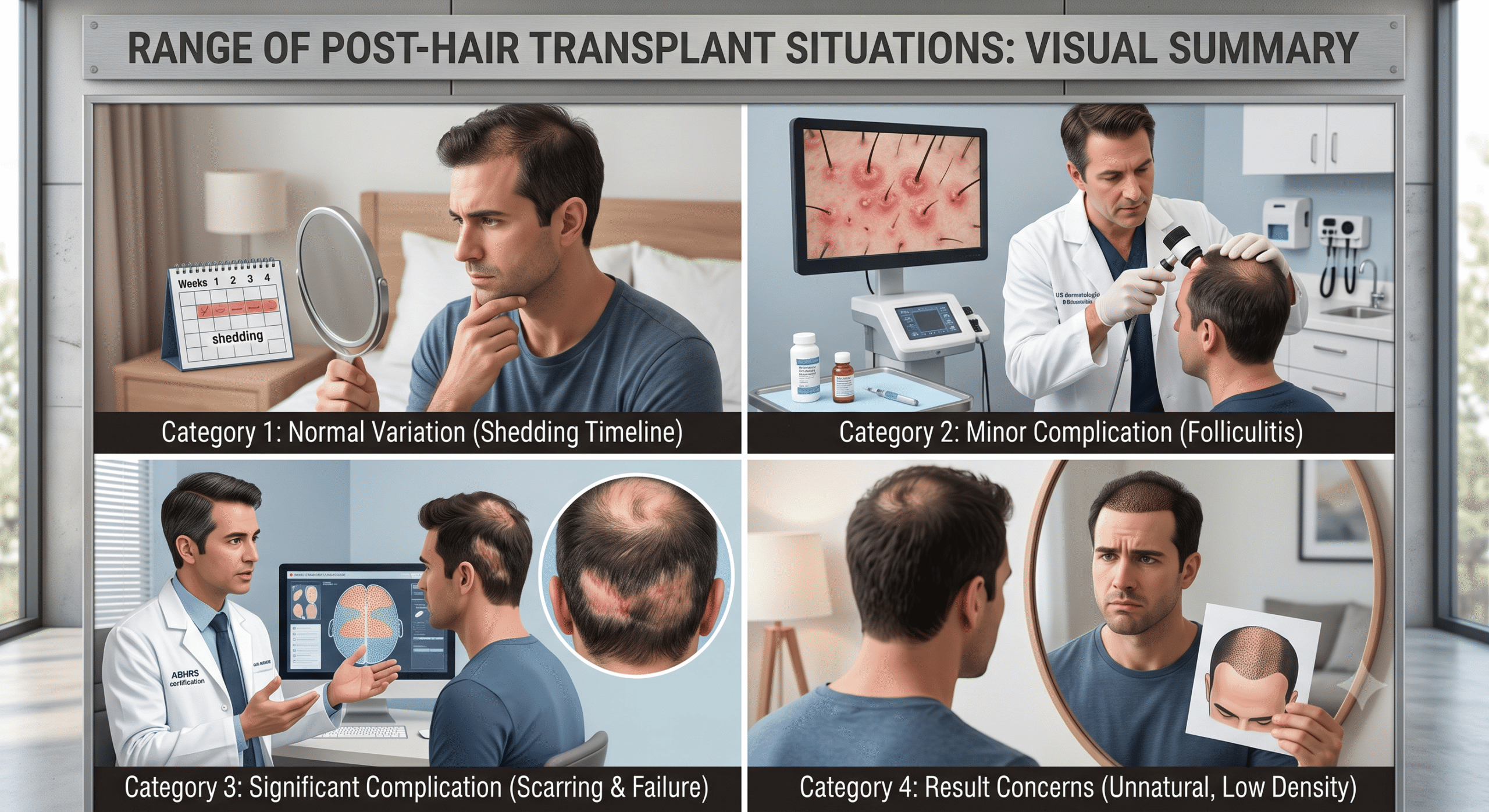
The shedding phase is the most psychologically challenging part of the American recovery experience because it occurs when the patient is home, alone with their concerns, and unable to attend an in-person clinic visit for reassurance.
Between approximately weeks two and six, the transplanted hairs begin to fall out. This is not a failure. It is the normal biological process by which the transplanted follicle enters its telogen resting phase before beginning permanent growth. The hair shaft falls; the follicle root remains alive beneath the scalp surface.
The scalp during peak shedding may look very similar to its pre-procedure state. For patients who were not clearly and repeatedly informed that this would happen, this appearance is alarming enough to trigger the belief that the procedure has failed. It has not.

Managing the shedding phase from the US:
Contact the EsteFavor clinical team through the remote follow-up channel. Submit photographs of the current scalp state. The team can confirm that what the patient is seeing falls within the normal shedding pattern for the procedure performed. This clinical confirmation, specific to the individual patient’s case, is more reassuring than any general online reassurance because it addresses the patient’s actual situation.
Continue the care protocol. The washing routine and prescribed products remain appropriate throughout the shedding phase. There is no clinical intervention that accelerates passage through this phase; consistent care and patience are the appropriate response.
Do not begin searching online for explanations of graft failure. Patient forums contain accounts of genuine graft failure alongside accounts of normal shedding that was misinterpreted as failure. Without clinical assessment of your specific case, self-diagnosis from forum posts is more likely to increase anxiety than to resolve it.
‘Bait-and-Switch Hair Transplant Clinics in Turkey: How Americans Spot the Token Doctor‘ – the shedding phase is the point at which patients who had procedures at lower-quality clinics begin to discover differences in graft survival; understanding what normal shedding looks like versus genuine graft failure signs is covered here alongside the clinic evaluation criteria that reduce the probability of reaching this situation.
Months Two to Four: The Dormant Phase
Following the shedding phase, the scalp enters a period of apparent inactivity. The shed hair has fallen, visible regrowth has not yet started, and the scalp looks largely unchanged for weeks. This is the dormant phase, and it is as normal as the shedding phase that preceded it.
The follicles are alive and resting. They will re-enter the active growth phase on their own biological timeline. Nothing the patient does, or avoids doing, meaningfully accelerates this timeline. This is one of the most difficult truths of hair transplant recovery: the patient is not in control of the pace, and accepting that is the most useful psychological adaptation available during this phase.
Most of the post-operative activity restrictions have lifted by the end of month one or early month two. Normal hair washing is appropriate. Light to moderate physical activity is appropriate. The scalp does not require the intensive management of the first weeks.
The one-month remote assessment with the EsteFavor clinical team, whether scheduled during the shedding phase or the early dormant phase, provides clinical confirmation that the recovery is proceeding normally. Preparing photographs according to the protocol specified by the clinic, in consistent natural light from the standard angles, allows the most useful clinical review.

Months Three to Five: Early Growth
The return of visible growth from the transplanted follicles typically begins between months three and five. This is the milestone that makes the shedding and dormant phases retrospectively comprehensible; the patient can see that the follicles have survived and are producing hair.
Early growth is not the final result. It is often fine, irregular in texture, and uneven in distribution across the recipient area. Different follicles re-enter the growth phase at different times, producing a progressive rather than simultaneous emergence. Evaluating the result at month four based on what is visible produces premature and often inaccurate conclusions.
Some patients experience early growth beginning at month three; others do not see clear evidence until month five or six. Both timelines are within the normal range. The rate of early growth is not a reliable predictor of the final result.
The three-month remote assessment with the EsteFavor clinical team captures this early growth phase. Photographs at this point allow the clinical team to assess whether the distribution and pace of emergence are consistent with the expected recovery trajectory for the specific procedure performed. For patients in the dormant phase at three months, this assessment confirms that the timeline is normal and provides a more specific expectation for when growth will begin.
Months Six to Nine: Progressive Development
By month six, the growth that was fine and irregular in texture at months three to five has matured and densified. A meaningful portion of the transplanted follicles have completed their initial growth cycle, and the coverage in the recipient area is progressively more visible and more representative of the eventual result.
The six-month assessment is the first point at which a substantive clinical evaluation of the developing result is possible. The clinical team can review the photographs against the pre-procedure baseline and the earlier assessment photos to assess whether the density, distribution, and hairline development are consistent with the planned result.
For most American patients at six months, the result looks noticeably different from the pre-procedure baseline and is continuing to develop. For patients whose result at six months is already substantially below the level of coverage that was planned, the six-month assessment is the appropriate point to raise this with the clinical team and discuss whether the timeline needs to be extended or whether the result at twelve months is likely to differ significantly from what is visible now.
Normal hair care continues to evolve through this period. By month six, virtually all post-operative restrictions have lifted. Normal styling, cutting, and colouring of the transplanted hair is appropriate, and the transplanted hair responds to these interventions exactly as natural hair does.

Months Nine to Twelve: Approaching the Final Result
By month nine, the result is substantially developed. The transplanted hair has thickened, the distribution across the recipient area has filled in, and the appearance is close to what the twelve-month result will show. Some additional maturation continues through month twelve, but the trajectory is clear.
For most American patients, this is the phase in which the emotional payoff of the journey becomes most evident. The hairline that was designed in the Istanbul consultation is visible. The density in the areas that were thinning or absent before the procedure has meaningfully increased. The hair behaves normally, grows continuously, and responds to cutting and styling as natural hair does.
The twelve-month assessment is the formal endpoint of the primary recovery period. The photograph series taken at this point, submitted to the EsteFavor clinical team for review, is compared against the pre-procedure photographs and the earlier assessment photos to document the result.
If the twelve-month result meets expectations, this assessment marks the completion of the primary procedure and follow-up cycle. If concerns remain about density, distribution, or any aspect of the result, this is the appropriate moment to discuss them with the clinical team and evaluate whether supplementary work is appropriate, feasible given donor supply, and what the clinical plan would look like.
Using the EsteFavor Remote Follow-Up Programme Effectively
The twelve-month follow-up programme that EsteFavor provides for American patients is only as valuable as the patient’s engagement with it. Patients who submit photographs at scheduled intervals, use the open-access channel for questions between assessments, and respond to clinical team communications promptly get substantially more from the programme than those who check in once and then disengage.
Practical guidance for effective programme use:
Photograph standardization: Take photographs at the same time of day, in the same lighting (natural light is best, avoid harsh artificial light), from the same angles, at each assessment point. The ability to make meaningful comparisons between months one, three, six, and twelve depends on consistency in the photography.
Response timing: Istanbul business hours are seven hours ahead of Eastern time. Submitting photographs and questions during US evening hours means the clinical team receives them at the start of their business day, which supports prompt responses.
Specific questions, not general anxiety: The most productive remote follow-up interactions involve specific, observable questions: “I have small bumps appearing in this area of the scalp at week eight, is this normal?” is more actionable than “I’m worried that nothing seems to be happening.” The clinical team can address specific observations; general worry is harder to address productively through a remote channel.
When to Seek US Medical Help
Most post-operative concerns during the twelve-month recovery period are best addressed through the EsteFavor remote follow-up programme. A small number of situations warrant local US medical attention:
Signs of active infection: Significant redness, warmth, swelling beyond what is expected, or pus formation in the scalp warrant assessment by a US physician, who can prescribe antibiotics or other treatment independently of the Istanbul clinical team. A brief message to the Istanbul team alongside the US doctor visit keeps both parties informed.
Systemic symptoms: Fever, swollen lymph nodes, or general illness symptoms alongside scalp changes warrant a US primary care visit. These are not expected outcomes of a hair transplant recovery, and their co-occurrence with scalp changes deserves professional assessment.
Persistent concerns at twelve months: A result that falls significantly short of expectations at the twelve-month mark warrants a consultation with a US-based ABHRS-certified surgeon for an independent assessment of what occurred and what corrective options are available.
Conclusion
The twelve months following a hair transplant in Turkey, managed from the United States, follow a predictable biological sequence that is entirely navigable with clear information, consistent care, and smart use of the remote support available. The shedding phase is normal. The dormant phase is normal. The progressive growth from month three to twelve is what the procedure was designed to produce.
The patients who navigate this period most successfully are those who left Istanbul with clear written instructions, understood the timeline before each phase arrived, and engaged actively with the EsteFavor remote follow-up programme at each scheduled milestone. The patients who find the recovery period most difficult are those who were inadequately prepared for the shedding phase, who abandoned the care protocol when the visual progress stalled, or who tried to evaluate the final result at four months rather than twelve.
The result at twelve months, for American patients who selected their clinic carefully and managed the recovery period well, is what made the journey to Istanbul worthwhile.
