
Reviews are the single most influential source of information American patients use when evaluating a Turkish hair transplant clinic, and they are also the most commonly misread. A five-star Google rating means something different from a longitudinal Reddit thread with photos at four time points. A glowing RealSelf review written one week after a procedure means something different from a HairLossTalk account updated at the twelve-month mark. Most American patients treat all of these sources as equivalent evidence. They are not.
This article explains how to read each major review platform correctly, what kind of evidence each one actually provides, and how to combine them into a genuinely reliable picture of a Turkish clinic’s quality.
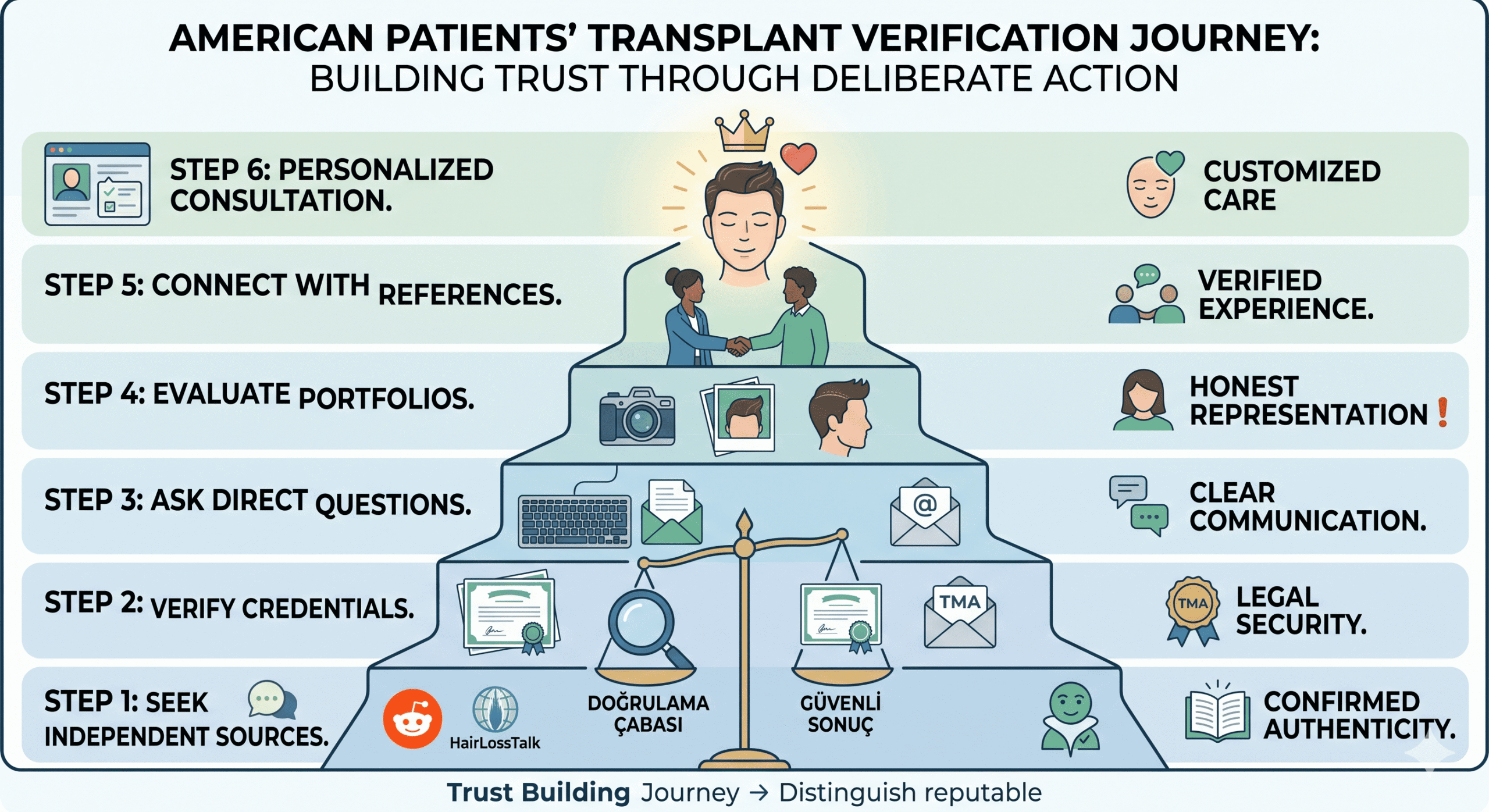
Why Hair Transplant Reviews Require a Different Reading Approach
Most consumer reviews, for a restaurant or a hotel, can be assessed accurately within days of the experience. A hair transplant cannot. The result of the procedure is not visible at one week, one month, or even six months. It is only assessable at twelve months, when the transplanted hair has completed its full growth cycle.
This timeline mismatch is the single most important thing to understand about hair transplant reviews. A patient who posts a five-star review one week after their procedure is rating their experience of the consultation, the clinic facility, the staff, and the immediate post-operative process, none of which tells you anything about whether the hair will actually grow in densely and naturally.
The reviews that matter most are the ones written, or updated, at the twelve-month mark, ideally with photographic documentation that allows independent visual verification of the claim being made.
Reading Reddit: r/HairTransplants
Reddit’s r/HairTransplants is widely regarded within the hair restoration community as the most reliable independent source of patient-generated information about specific clinics, because the platform structure rewards detailed, photo-documented posts and because the community actively scrutinizes claims.
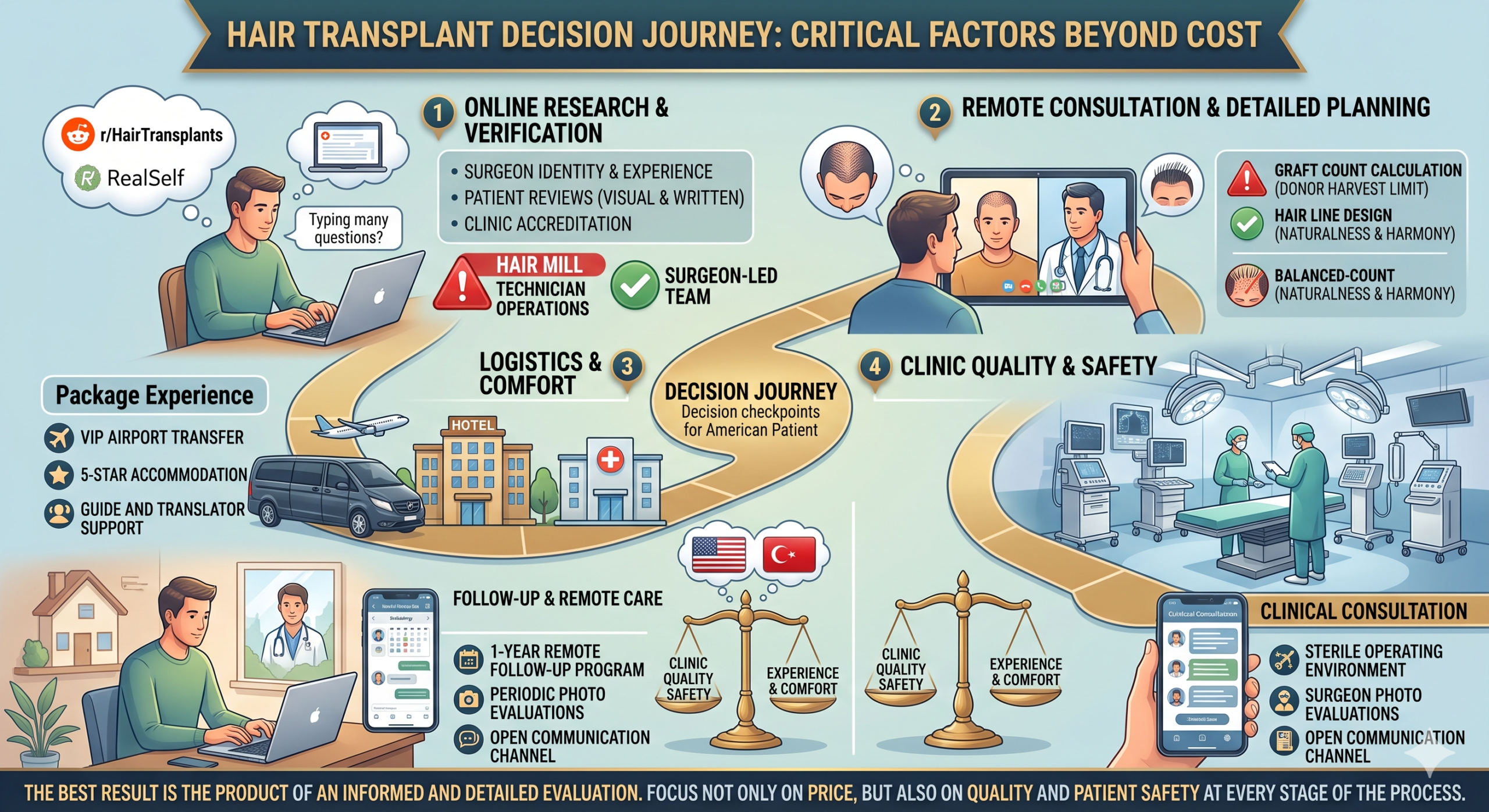
What makes a Reddit post genuinely useful:
- Multiple time-stamped photo updates within a single thread or across linked posts: pre-procedure, one month, three months, six months, twelve months
- Specific clinic and surgeon names, not vague references to “a Turkey clinic”
- Graft count and technique disclosed, allowing comparison to your own situation
- Honest texture, including complaints about minor things like the food, the wait time, or specific aspects of the experience that were imperfect, alongside the praise
- Community engagement, where other users ask questions and the original poster responds with additional detail or photos
Search strategy for Reddit:
Use Reddit’s search function directly, searching the specific clinic name within r/HairTransplants. Google site-search also works well: searching “site:reddit.com r/HairTransplants [clinic name]” often surfaces threads that Reddit’s internal search misses.
Look specifically for posts with “update” in the title, which typically indicate a patient returning to add later-stage photos to an earlier post. A single post with only immediate post-operative photos and no follow-up update is incomplete evidence.
Red flags within Reddit threads:
- Accounts with no posting history beyond hair transplant content, which can indicate clinic-created or incentivized accounts
- Suspiciously polished, marketing-style language inconsistent with how real patients typically write
- Photos that appear in multiple different threads under different patient names (reverse image search can verify this)
- A pattern of new accounts appearing to defend a specific clinic whenever it is criticized

What Reddit does not provide:
Reddit threads are not a representative sample. Patients with strongly positive or strongly negative experiences are more likely to post than those with average, unremarkable outcomes. A clinic with twenty positive Reddit threads and no negative ones may simply have not yet generated a dissatisfied patient who chose to post, rather than having a perfect track record. Use Reddit as one input, not the complete picture.
Reading RealSelf
RealSelf is a platform built around verified reviews for cosmetic and aesthetic procedures, including hair transplants. Its structure differs meaningfully from Reddit’s.
What RealSelf provides:
- Star ratings and a “Worth It” percentage based on aggregated patient sentiment
- Shorter, structured reviews rather than long-form narrative posts
- Some doctor responses to reviews, which can reveal how a clinic handles criticism
- Before and after photo galleries, though these are typically clinic-submitted rather than fully independent
How to read RealSelf accurately for hair transplants:
The “Worth It” percentage is a useful filter for eliminating clearly poor performers but should not be treated as a precise quality score. A clinic with an 85% Worth It rating is meaningfully different from one with a 95% rating, but the difference between 91% and 94% is statistically less reliable given typical review volumes.
Read the written reviews, not just the star rating. Look specifically for reviews mentioning the timeline, “Posted at 12 months” is more valuable than “Posted at 2 weeks.” RealSelf allows reviewers to update their reviews over time. Check whether reviews have been updated and what the update added.
RealSelf’s limitations specific to international clinics:
RealSelf’s verification process is more robust for US-based providers, where doctor credentials are checked against US medical board databases. For international providers, verification processes are less standardized, and the platform’s quality control for Turkish clinic listings has been less consistent than for domestic providers. Treat RealSelf as a useful supplementary source for Turkish clinics, not a primary verification tool.

‘How Americans Can Verify a Turkish Hair Transplant Clinic Before Booking‘ – the complete verification framework that combines review reading with credential checks, written clinic questions, and reference contact to produce a comprehensive evaluation before booking any Turkish clinic.
Reading HairLossTalk and HairRestorationNetwork
These two dedicated hair loss forums predate Reddit’s prominence in this space and remain valuable specifically because their communities are composed of long-term participants deeply engaged with hair restoration topics specifically, rather than general Reddit users.
What these forums provide that Reddit and RealSelf do not:
- Years-long thread histories from individual patients, sometimes spanning multiple procedures and several years of follow-up
- Highly technical discussion among community members who understand graft survival rates, FUE versus FUT trade-offs, and the biology of the growth cycle in detail
- Clinic-specific subforums in some cases, where patients who have used the same clinic congregate and compare notes directly
- A more stable, long-term member base that is harder to manipulate with newly created accounts than Reddit’s more transient community
How to navigate these forums:
Both platforms use traditional forum software with searchable threads organized by topic. Search the specific clinic name, and look for threads with substantial reply counts, since longer threads typically indicate sustained community engagement and scrutiny.
Pay attention to which “veteran” members, those who have been active on the forum for years and have established credibility, comment on specific clinics. Their assessments carry more weight than anonymous newer accounts because their posting history can be reviewed for consistency and expertise.
Cross-Referencing: The Method That Actually Works

No single platform provides a complete picture. The reliable approach combines evidence across platforms using a specific cross-referencing method:
Step one: Identify the clinic’s presence across all platforms. Search the clinic name on Reddit, RealSelf, HairLossTalk, and HairRestorationNetwork. A clinic with a consistent positive presence across multiple independent platforms is more reliably evaluated than one with reviews concentrated on a single source.
Step two: Look for the same patient or similar accounts across platforms. Some patients post their experience on multiple platforms. Finding the same narrative, with consistent details, across Reddit and a dedicated forum adds confidence to the account’s authenticity.
Step three: Weight twelve-month evidence above all else. Across every platform, prioritize accounts that include twelve-month or later documentation. Discount accounts that only show immediate post-operative results, regardless of how positive the framing.
Step four: Look specifically for negative or mixed reviews. A clinic with only uniformly positive reviews across every platform, with no documented complaints, minor criticisms, or mixed experiences, is statistically unusual. Real clinical experiences, even good ones, typically include some texture: a longer than expected wait, a minor communication issue, an aspect of the experience that did not match expectations exactly. The complete absence of any negative texture is itself worth noting as potentially indicating curated or incentivized review presence.
Step five: Verify specific claims independently. If a review claims a specific graft count, technique, or surgeon name, verify this is consistent with what the clinic’s own marketing claims and with what the clinic tells you directly during your own consultation. Inconsistencies between what reviewers report and what the clinic represents to you are worth raising directly.
What to Do When Reviews Are Limited
For newer clinics or those that have not yet built a substantial independent review presence, American patients face a more difficult evaluation challenge. In this situation:
Weight the credential verification process more heavily. Without substantial independent review evidence, the credential checks described in clinic verification, Turkish Medical Association registration, JCI accreditation, Ministry of Health registration, become proportionally more important.
Request direct reference contact. A newer clinic that cannot yet point to a large body of independent reviews should still be able to connect prospective patients with former patients directly. The willingness to facilitate this connection is itself informative.
Apply additional scrutiny to the remote consultation process. The quality, specificity, and transparency of the remote consultation becomes a more significant evidence source when independent review history is limited.
Consider the parent organization or surgeon’s prior track record. Sometimes a newer clinic is associated with a surgeon who has an established track record at a different facility, or whose individual case history can be reviewed independently of the clinic’s overall review history.

Common Review Reading Mistakes American Patients Make
Mistake one: Treating star ratings as precise measurements. A 4.8 versus 4.6 star rating across a small sample size is not a meaningful quality differentiator. Read the actual content of reviews rather than relying on aggregate scores alone.
Mistake two: Being swayed by review volume rather than review quality. A clinic with five hundred reviews is not necessarily better evaluated than one with fifty, if the five hundred are short, generic, and lack photographic documentation while the fifty include detailed twelve-month accounts with photos.
Mistake three: Ignoring the absence of negative reviews as a positive sign. As discussed above, the complete absence of any negative or mixed feedback across a clinic’s entire review presence is statistically unusual and warrants scrutiny rather than reassurance.
Mistake four: Not checking review dates and procedure dates separately. A review posted in 2026 describing a procedure that took place in 2022 reflects clinic standards from several years ago. Clinics change, sometimes for better, sometimes for worse, as ownership, staff, and management practices evolve. Recent reviews about recent procedures are more relevant than older reviews, even highly detailed ones.
Mistake five: Relying exclusively on the clinic’s own curated testimonial page. This bears repeating because it is the most common mistake of all. A clinic’s own website testimonials are the least independent, least verifiable source of review evidence available, regardless of how detailed or convincing they appear.
How EsteFavor’s Independent Review Presence Holds Up
American patients applying this reading framework to EsteFavor will find a pattern consistent with what reputable Istanbul clinics should demonstrate: documented patient accounts across independent platforms including longitudinal photo updates, a presence that extends beyond the clinic’s own marketing materials, and a willingness to connect prospective patients with references who can speak directly to their experience.
The clinic encourages exactly the cross-referencing process described in this article. American patients evaluating EsteFavor are welcome to search independent platforms, request references, and verify credentials through the official channels described elsewhere in this series, before, not instead of, engaging in a direct consultation.
‘Hair Transplant in Turkey vs USA: What Americans Actually Get for the Price Difference‘ – the documented results from American patient communities discussed in this article are part of the broader evidence base for evaluating whether a reputable Istanbul clinic delivers comparable outcomes to a domestic procedure at a fraction of the cost.
Conclusion
Reading hair transplant reviews accurately requires understanding that different platforms provide different kinds of evidence, that timing matters more than almost any other factor in evaluating a posted result, and that the absence of negative feedback is not the reassurance it appears to be on the surface.
American patients who cross-reference Reddit, RealSelf, HairLossTalk, and HairRestorationNetwork, who prioritize twelve-month documentation over immediate post-operative enthusiasm, and who treat the complete absence of any critical feedback with appropriate skepticism, will arrive at a genuinely reliable picture of clinic quality, the kind of picture that no single review platform, read in isolation, can provide.
