
American patients researching hair transplants in Turkey encounter something that rarely comes up when they research domestic options: clinics offering 4,000, 5,000, or even 6,000 grafts in a single day. In the US, most board-certified surgeons treat 1,500 to 3,000 grafts as a standard session range. The disparity prompts a reasonable question: is the Turkish mega-session a clinical advancement, an efficiency that benefits patients, or a risk factor that Americans should understand before accepting a large graft proposal?
The answer is nuanced, clinician-dependent, and more consequential for some patients than others. This article explains what mega-sessions actually involve, what the specific risks are, how to evaluate a proposed graft count, and when the multi-session approach that American surgeons typically recommend is clinically justified.
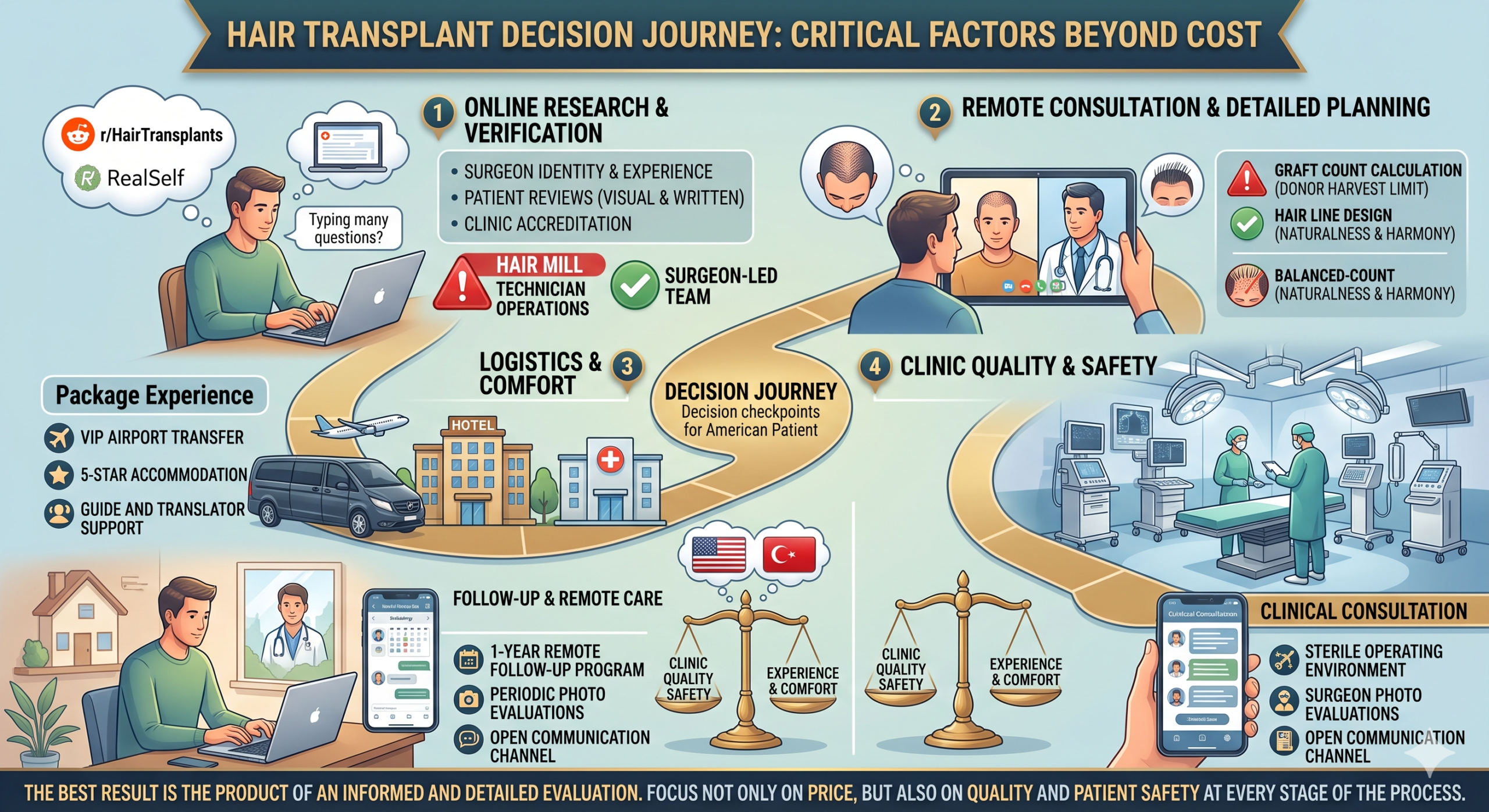
What Constitutes a Mega-Session
There is no universally agreed definition of a mega-session, but the term is generally applied to single-day procedures involving 3,500 or more grafts. Some sources set the threshold at 4,000 or higher.
In practice, the relevant variables are:
- Total graft count: How many individual follicular units are extracted and implanted
- Session duration: A 4,000-graft procedure typically runs eight to twelve hours
- Donor area characteristics: The density and total area from which extraction occurs
- Anaesthetic volume required: Local anaesthetic must be administered repeatedly throughout the session
- Team fatigue and precision over time: Extraction and implantation quality can decline as a long session progresses
The mega-session is common in Istanbul because the market structure favours it. Clinics priced on all-inclusive packages have a commercial incentive to maximise graft count in a single session. Patients seeking the most complete result in a single trip are drawn to high graft count proposals. Both forces push toward larger single-day sessions than most US practitioners would recommend.
The Specific Medical Risks
American board-certified surgeons, including practitioners cited in the American Board of Cosmetic Surgery and ABHRS literature, have identified several specific risks associated with very large single-day sessions:
Lidocaine toxicity: Local anaesthetic is administered to both the donor and recipient areas, and re-administered multiple times throughout a long procedure as the anaesthetic wears off. The total volume of local anaesthetic used in a very large session can approach toxic thresholds. The two hair transplant-related deaths reported in Turkey in 2025 are believed by some practitioners to involve lidocaine toxicity, though without transparent post-incident reporting it is impossible to confirm definitively.
The risk is real and manageable with appropriate dosing protocols and patient monitoring: but it is a risk that increases with session length and total anaesthetic volume in ways that smaller sessions avoid.

Reduced graft survival at high volumes: Extracted follicles are living tissue that survives best when maintained outside the body for the shortest possible time. In a very large session, grafts extracted early in the process may spend several hours in storage before the implantation phase reaches them. Extended out-of-body time reduces viability. At very high graft counts, the grafts implanted late in the session have spent meaningfully longer outside the body than those implanted early: and this affects survival rates.
Team precision over extended sessions: The extraction phase of a 5,000-graft procedure requires high-precision punch movements repeated thousands of times over several hours. The implantation phase requires the same sustained precision in a different technical form. Human performance in precision tasks degrades over extended periods. An extraction performed in hour one of a session is not identical in precision to the same movement performed in hour eight.
Donor area over-harvesting: Very large single sessions require extraction from a larger area of the donor zone or at higher density within the standard zone. The risk of creating visible thinning or scarring in the donor area increases when extraction is aggressive. Donor area damage is one of the most difficult outcomes to address because the supply is finite and cannot be regenerated.
‘Is a Hair Transplant in Turkey Safe for Americans? What ISHRS and ABHRS Data Actually Shows‘ – the ISHRS safety data on Turkey’s hair transplant market, including the specific risk profile of high-volume, technician-led clinics where mega-sessions are most commonly offered.

When Large Sessions Are Clinically Justified
The risks described above do not mean that every large graft session is inappropriate. Several factors determine whether a high graft count in a single session is clinically sound for a specific patient:
Patient’s degree of hair loss: A patient with advanced hair loss covering the hairline, mid-scalp, and crown may genuinely need 3,500 to 4,500 grafts to achieve meaningful coverage. For this patient, a staged approach that requires two separate trips to Istanbul adds logistical and financial complexity that a single well-managed session avoids.
Donor area density and total supply: A patient with high donor density and a large donor area can sustain higher-volume extraction without approaching the safe extraction limit. The safe limit is patient-specific, not a universal number.
Technique and team quality: A highly experienced surgical team using well-established technique can manage larger sessions with lower complication probability than a lower-experience team in a production-line environment. The same graft count carries different risk at different clinics.
Session management protocols: Clinics that manage large sessions with appropriate anaesthetic monitoring, temperature-controlled graft storage solutions, structured session pacing, and genuine surgeon oversight throughout are managing the specific risks described above. Clinics that maximise speed and volume without these protocols are not.
The clinical question is therefore not “is 4,000 grafts too many?” in the abstract. It is “is 4,000 grafts appropriate for this patient, managed by this team, using these protocols?”

How to Evaluate a Turkish Clinic’s Graft Proposal
When an Istanbul clinic proposes a graft count for an American patient’s consultation, the patient should evaluate the proposal rather than accepting it at face value.
Ask how the count was determined: A clinically grounded graft proposal is derived from a documented assessment of donor density, hair calibre, the area to be covered, the desired density in the recipient area, and the safe extraction limit from the donor zone. If the proposed count was not derived from this kind of assessment, it is a commercial proposal rather than a clinical one.
Compare the proposal to independent assessment: American patients who have had a consultation with a US-based ABHRS surgeon before going to Turkey have a baseline graft estimate to compare against. A Turkish proposal significantly above the US estimate warrants a specific question about the discrepancy.
Ask about the safe extraction limit for your donor area: A reputable clinic can tell you specifically what the maximum safe graft count from your donor area is without compromising the donor zone. A clinic that does not discuss this constraint is not planning conservatively for your long-term donor supply.
Ask about the procedure timeline: A 4,000-graft procedure should take approximately eight to twelve hours with an experienced team moving at a responsible pace. A proposed timeline significantly shorter than this for a large graft count suggests either that the procedures will be performed simultaneously on multiple patients by the same team, or that speed is being prioritised over precision.
The Multi-Session Argument
Many American board-certified surgeons recommend staging procedures across two sessions rather than performing very large single-day operations. The clinical argument is:
- Each session remains within a graft count range where the specific risks above are lower
- The donor area recovers between sessions, reducing the risk of accumulated trauma
- The result of the first session can be assessed before the second is planned, allowing the surgical strategy to be refined based on actual outcomes
- Anaesthetic volume per session remains within lower-risk ranges
The practical counterargument for most American patients travelling to Turkey is logistical: a staged approach requires two international trips, potentially months apart, with the associated cost and leave implications. For patients with the financial flexibility and the degree of hair loss that warrants a staged approach, the two-session model has genuine clinical merit. For patients in the moderate graft count range who are making a single trip, a well-managed single session at a reputable clinic is the appropriate approach.
‘Hair Transplant Cost in Turkey vs USA: New York, Miami and LA Price Comparison 2026‘ – how the cost structure of Istanbul all-inclusive packages relates to the graft count discussion, and why commercial incentives in the Turkish market push toward larger proposed sessions than US surgeons typically recommend.
Red Flags in Graft Proposals
Specific features of a graft proposal that should prompt additional scrutiny:
“Unlimited grafts” packages: Some Turkish clinics market unlimited graft packages at a fixed price. As the ISHRS notes, unlimited grafts is marketing language, not medicine. Donor supply is finite. A clinic that does not acknowledge this constraint is not planning based on your clinical reality.
Graft counts significantly above what US consultation produced: A major discrepancy between a US surgeon’s estimate and a Turkish clinic’s proposal deserves specific explanation. The discrepancy may reflect different assessment methods, different planning approaches, or a commercially motivated inflation of the proposed count.
No mention of donor area limits: A reputable clinic discusses the constraints of your specific donor area as part of the planning process. A clinic that focuses exclusively on what can be achieved in the recipient area without discussing donor supply limitations is not giving you a complete clinical picture.
Very high counts proposed without scalp analysis data: A proposal for 4,500 or 5,000 grafts that is not backed by documented scalp analysis measurements: donor density, hair calibre, safe extraction estimate: is a commercial proposal based on what sells, not a clinical plan based on what your scalp can sustain.
What a Responsible Session Looks Like
A clinically responsible hair transplant session for most American patients involves:
- A graft count derived from objective scalp analysis data
- A plan that stays within the safe extraction limit for the individual donor area
- A session duration that allows quality execution of each graft rather than prioritising throughput
- Appropriate anaesthetic management throughout the session
- A surgeon present and engaged throughout the operative session
- Post-operative care that begins before the patient leaves the clinic
At EsteFavor, every graft count is derived from a documented pre-operative scalp analysis that assesses donor density and the realistic safe supply. Session planning reflects clinical reality, not commercial maximisation. American patients who have been quoted very large graft counts at other clinics and who want an independent clinical assessment of whether that count is appropriate for their specific situation are encouraged to use the EsteFavor remote consultation as a second opinion before committing anywhere.
‘How Americans Can Verify a Turkish Hair Transplant Clinic Before Booking’ – the verification framework for Turkish clinics includes specific questions about graft count determination and donor area assessment that allow American patients to distinguish clinically grounded proposals from commercially inflated ones.
Conclusion
Hair transplant mega-sessions in Turkey are not uniformly dangerous, and they are not uniformly safe. The risk profile depends on the specific graft count, the patient’s donor area characteristics, the clinical team’s experience, the session management protocols, and the presence or absence of genuine surgical oversight throughout.
For American patients, the key practical steps are to get an independent US consultation before going to Turkey, compare any Turkish clinic’s proposal against the US estimate, ask specific questions about how the proposed graft count was determined and what the safe extraction limit for their donor area is, and treat any proposal that does not engage with these questions specifically as one that deserves more scrutiny before any commitment is made.
