
The surgery is done. The grafts are in. And now begins the phase most patients are least prepared for: thirty days of healing that looks worse before it looks better, and feels confusing at almost every stage. Swelling you were not warned about, scabs you are afraid to touch, hair that falls out just when you thought it was growing in. None of this is failure. All of it is biology doing exactly what it should.
This guide walks through the first thirty days day by day and week by week — what is happening under the skin, what you will see in the mirror, and what to do or avoid at each stage. There are no surprises here if you read it before they happen.

The First 72 Hours: The Critical Window
The first three days after a hair transplant are the most medically important of the entire recovery. Grafts that have been placed into recipient channels have not yet established a blood supply. They are sitting in place, anchored by nothing more than the wound itself and the early formation of fibrin. Mechanical disturbance during this window — rubbing, pressure, a strong shower stream, sleeping face-down — can physically dislodge them.
Swelling
Swelling typically peaks on Day 2 or 3. The anaesthetic fluid injected during the procedure contains saline and adrenaline, and gravity pulls it forward and downward over the following days. Many patients wake on Day 3 with a puffy forehead or slight swelling around the eyes. This is normal and resolves on its own within a day or two. A cold compress applied to the forehead — not to the grafts themselves — can reduce the swelling faster.
Sleeping with your head elevated at 30–45 degrees is the single most effective thing you can do in the first week. It reduces swelling, protects the grafts from pressure, and keeps blood from pooling in the recipient area. Use a travel neck pillow or stack pillows under your upper back, not just your head.
Pain and discomfort
Most patients describe the day-one discomfort as a tight, achy feeling — closer to a sunburn than to surgical pain. The donor area tends to feel more sore than the recipient zone, particularly with FUE where the extraction sites are distributed across the back and sides of the scalp. Prescribed pain relief handles this comfortably for the majority of patients, and most require it for no more than two to three days.

The no-touch rule
During the first 72 hours, keep your hands completely away from the graft area. No touching to check whether they feel secure, no adjusting, no scratching, no hat that presses against the transplanted zone. The grafts are physically vulnerable and the temptation to investigate them is understandable — resist it entirely.
Days 4–14: Scabs, Washing, and Looking Presentable
By Day 4 or 5, most clinics clear patients to begin washing. The technique matters: water should be poured or dripped gently over the scalp, never directed at it under shower pressure. The goal is to keep the area clean without applying any friction that could disturb graft sites that are still forming their anchoring tissue.
Scabs
Small crusts form around each graft site during the first several days. These are part of the normal wound-healing response and serve a protective function. They fall away naturally as washing continues — typically by Day 10 to 14 for most patients. The rule is straightforward: do not pick them. Pulling a scab before it is ready can remove the graft shaft along with it. The follicle beneath would survive, but early shedding of the shaft is unnecessary and avoidable.
By the end of Week 2, most patients look presentable enough to return to desk work. The obvious signs of surgery — redness, visible scabbing, the short-cropped appearance of the freshly transplanted zone — have largely resolved. This is also when the grafts have anchored firmly enough that the risk of mechanical dislodgement drops significantly.

The donor area
For Sapphire FUE and DHI procedures, the donor area consists of many small extraction points distributed across the back and sides of the scalp. These heal quickly — most are fully closed within a week — and leave no linear scar. Some redness and a slight stubble appearance in the donor zone is normal in the first two weeks.
The 30-Day Timeline: Day by Day
The table below summarises what is happening at each stage of the first thirty days, and what it means for your behaviour and expectations.
| Day / Period | What is happening | What you need to know |
| Day 1 | Procedure day | Bandage applied to donor area. Scalp is tender, some tightness. Sleep at 30–45° elevation. No touching the grafts. |
| Day 2–3 | Swelling peaks | Forehead and eye area may puff — gravity pulls the anaesthetic fluid downward. Cold compress on forehead (not on grafts). Continue elevated sleep. |
| Day 4–5 | First wash | Clinic-approved gentle wash begins. Pour water softly over the recipient zone — no direct shower pressure. Pat dry only. |
| Day 6–7 | Scabs forming | Small crusts form around each graft. This is normal and protective. Do not pick or rub. Redness begins to fade in the donor area. |
| Day 8–10 | Scabs softening | Continued gentle washing loosens scabs naturally. Most fall away on their own by day 10–14. Sensitivity decreasing. |
| Day 11–14 | Scalp normalising | Most scabs gone. Redness fading. Grafts are now anchored — mechanical trauma risk drops significantly. Many patients return to office work. |
| Day 15–21 | Shock loss begins | Transplanted hair shafts begin to shed. This is expected and does not mean the graft has failed — the follicle stays in place and will regrow. |
| Day 22–30 | Shock loss continues | Shedding may intensify. The scalp looks sparse — this is the lowest cosmetic point of the entire process. New growth begins underground. |
Table 1. First 30 days after hair transplant: timeline overview.
Shock Loss: The Part Nobody Likes
Shock loss is the most psychologically difficult phase of hair transplant recovery, and it happens to the majority of patients between weeks 2 and 4. Transplanted hair shafts — the visible part of the hair above the skin — begin to shed. For patients who were not warned, this looks and feels like the transplant is failing.

It is not failing. The follicle — the living structure beneath the skin that produces hair — remains intact in its new location. The shaft shedding is a response to the trauma of transplantation: the follicle enters telogen, the resting phase of the hair cycle, and the existing shaft is released. New growth will emerge from the same follicle, typically beginning around months 3 to 4. The shed shaft is the old hair. The growth that follows is permanent.
Shock loss can also affect some native hairs in the area surrounding the transplant zone — hairs that were not transplanted but were disturbed by the procedure. These typically regrow as well, though the timeline can vary. It is worth noting that if a native hair sheds during this period and does not return, it was likely already in the late stages of miniaturisation and would have been lost regardless.At day 30, most patients are at the lowest cosmetic point of the entire process. The scalp looks sparse. The initial post-surgery appearance has been replaced by something that can look worse. This is temporary and expected. Growth begins underground during this period and will become visible in the weeks ahead.
What You Can and Cannot Do: The 30-Day Reference
The table below is a practical do-and-don’t reference for the first month. Clinic instructions always take precedence over general guidance — your surgeon’s specific protocol may differ at certain points.
| ✓ Do this | × Avoid this |
| Sleep at 30–45° for the first 7 nights | Sleep flat or on your stomach |
| Wash gently with clinic-approved technique from Day 4–5 | Rub, scrub, or use strong shower pressure on grafts |
| Let scabs fall away on their own | Pick, scratch, or forcibly remove scabs |
| Take prescribed medication as directed | Skip antibiotics or anti-inflammatories |
| Protect scalp from direct sun — loose hat after Day 5 | Wear a tight hat or helmet that touches the grafts |
| Stay hydrated and eat normally | Drink alcohol in the first 2 weeks |
| Resume light walking from Day 5–7 | Exercise, sweat heavily, or swim for 4 weeks |
| Contact the clinic if you see signs of infection | Wait and hope if redness is spreading or you have a fever |
Table 2. Do and avoid during the first 30 days post-transplant.
When to Contact the Clinic
Most of what happens in the first 30 days is normal and expected. But there are specific signals that warrant contacting your clinic rather than waiting.

Signs of infection: Redness that is spreading beyond the immediate graft area, swelling that is increasing rather than decreasing after Day 5, warmth to the touch, discharge from graft sites, or fever. Infection is uncommon in properly conducted procedures but can occur, and early treatment is straightforward if caught quickly.
Persistent bleeding: A small amount of spotting on the pillow for the first night or two is normal. Active bleeding that does not stop with gentle pressure, or bleeding that begins again after Day 3, should be reported.
Graft loss at scale: Scabs coming away with small hairs attached is normal. If you see what appears to be intact graft material — tissue rather than just a hair shaft — or if a large area of the recipient zone appears bare and raw, contact the clinic.
Unusual pain pattern: Pain that is worsening rather than improving after Day 3, or pain that is localised to a specific point rather than general tenderness, should be assessed.
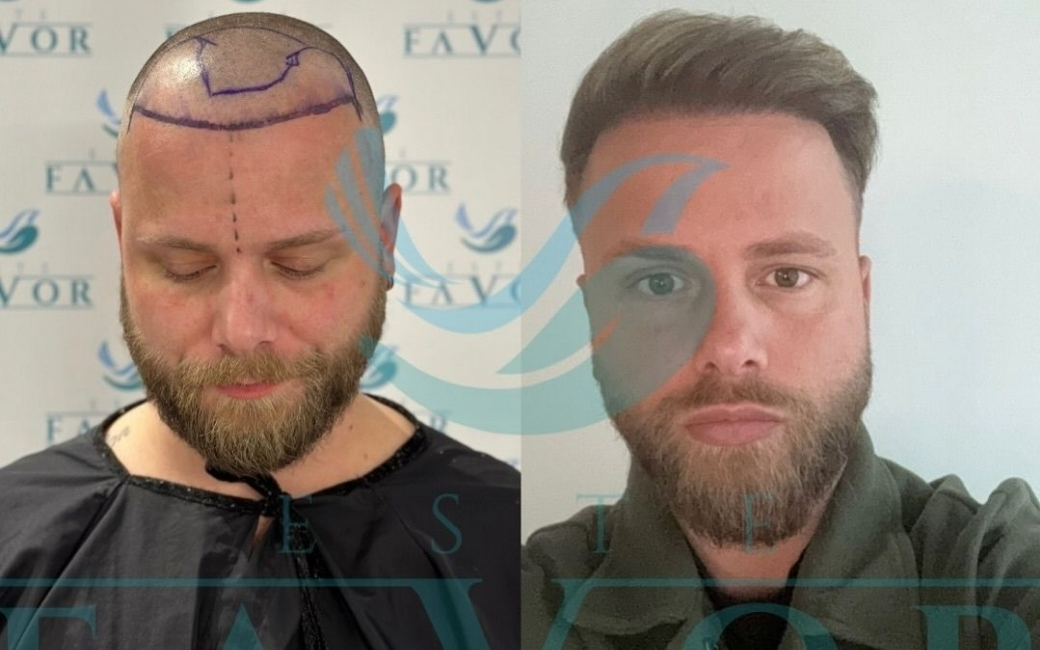
What Happens After Day 30
Day 30 is not the end of the recovery — it is roughly the beginning of the waiting phase. The follicles are now established in their new positions. The shedding that has occurred or is still occurring is the final phase of the biological reset. What follows is a gradual, steady progression toward the full result.
Most patients begin to see the first fine new hairs emerging around months 3 to 4. These early hairs are thin, sometimes lighter in colour than the rest of the hair, and can have a slightly different texture initially. They thicken and mature as the follicle completes its first full growth cycle in its new location. Density continues to improve through months 6 to 9, with the final result typically visible at 12 months. The crown, if transplanted, may take slightly longer — up to 14 to 18 months.

The One Thing That Determines Your Result in Month One
Surgical outcome is primarily determined by the quality of the procedure itself: graft handling, channel depth and angle, surgeon technique. You cannot improve on what happened in the operating room. What you can control in month one is whether you protect what was placed.
The patients who leave month one in the best position are not the ones who found special treatments or supplements. They are the ones who followed the washing protocol correctly, slept at the right angle for the first week, kept their hands off the grafts, and called the clinic when something looked wrong rather than searching for forum reassurance instead. The biology takes care of the rest.
